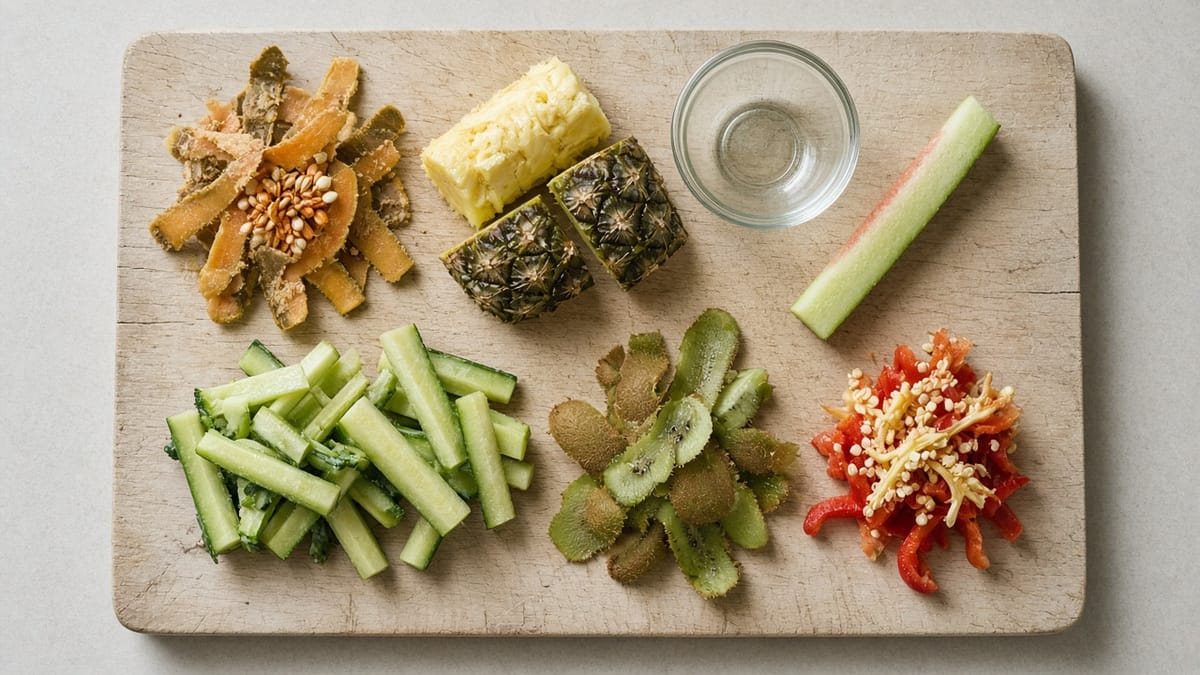
Peels, skins, seeds and stalks contained more dietary fibre than the parts people usually eat in 10 of 12 types of raw produce tested by researchers at King’s College London, the university said on 30 October. The values ran from 2.10 g per 100 g in watermelon rind to 9.25 g in butternut squash skin and seeds. Measured against the EU’s nutrition-claim thresholds, that range spans both claims: the lowest value falls short of “source of fibre” by weight, and the highest clears “high fibre”. The researchers say population-level gains need changes in food manufacturing and eating out, which puts the next step with product developers and caterers.
At a glance
- 10 of 12produce types where discarded parts held more total dietary fibre than the eaten parts
- 9.25 gfibre per 100 g in butternut squash skin and seeds, above the EU “high fibre” level of 6 g
- 25–48%share of produce weight made up of the usually discarded parts
- 4%of UK adults who reach the recommended 30 g of fibre a day
King’s College London, 30 October 2026; Browne et al., International Journal of Food Sciences and Nutrition, 2026; Regulation (EC) No 1924/2006.
What the King’s team measured
The study, by Georgia Browne, Rachel Gibson, Balazs Bajka and colleagues, was published on 29 October in the International Journal of Food Sciences and Nutrition. It quantified total dietary fibre in the usually eaten and usually discarded parts of 12 raw fruits and vegetables common in UK foodservice, among them butternut squash, peppers, broccoli, kiwi fruit, pineapple and watermelon. Pineapple skin and core held 453.7% more fibre than the flesh. Broccoli was one of the exceptions: its stalks held 28.4% less fibre than the florets.
The discarded parts made up 25–48% of the weight of the produce, Gibson said. The team also ran a focus group of 40 King’s staff and students before launching a root-to-tip menu in King’s Food venues. Participants described “mental discomfort” about eating these parts, worried about digestibility and found little reliable nutrition information online. Lead author Browne said participants saw fibre as a stronger reason to try root-to-tip eating than environmental benefit.
The gap the study points at is large. Only 4% of UK adults meet the 30 g daily recommendation, and average intake is 16.4 g, King’s said. The UK wastes about 10 million tonnes of food a year, 36% of it fresh fruit and vegetables.
Where the EU claim thresholds fall
Under the annex to Regulation (EC) No 1924/2006, a food may claim to be a “source of fibre” at 3 g per 100 g or 1.5 g per 100 kcal, and “high fibre” at 6 g per 100 g or 3 g per 100 kcal. The chart sets the two published extremes against the per-weight thresholds.
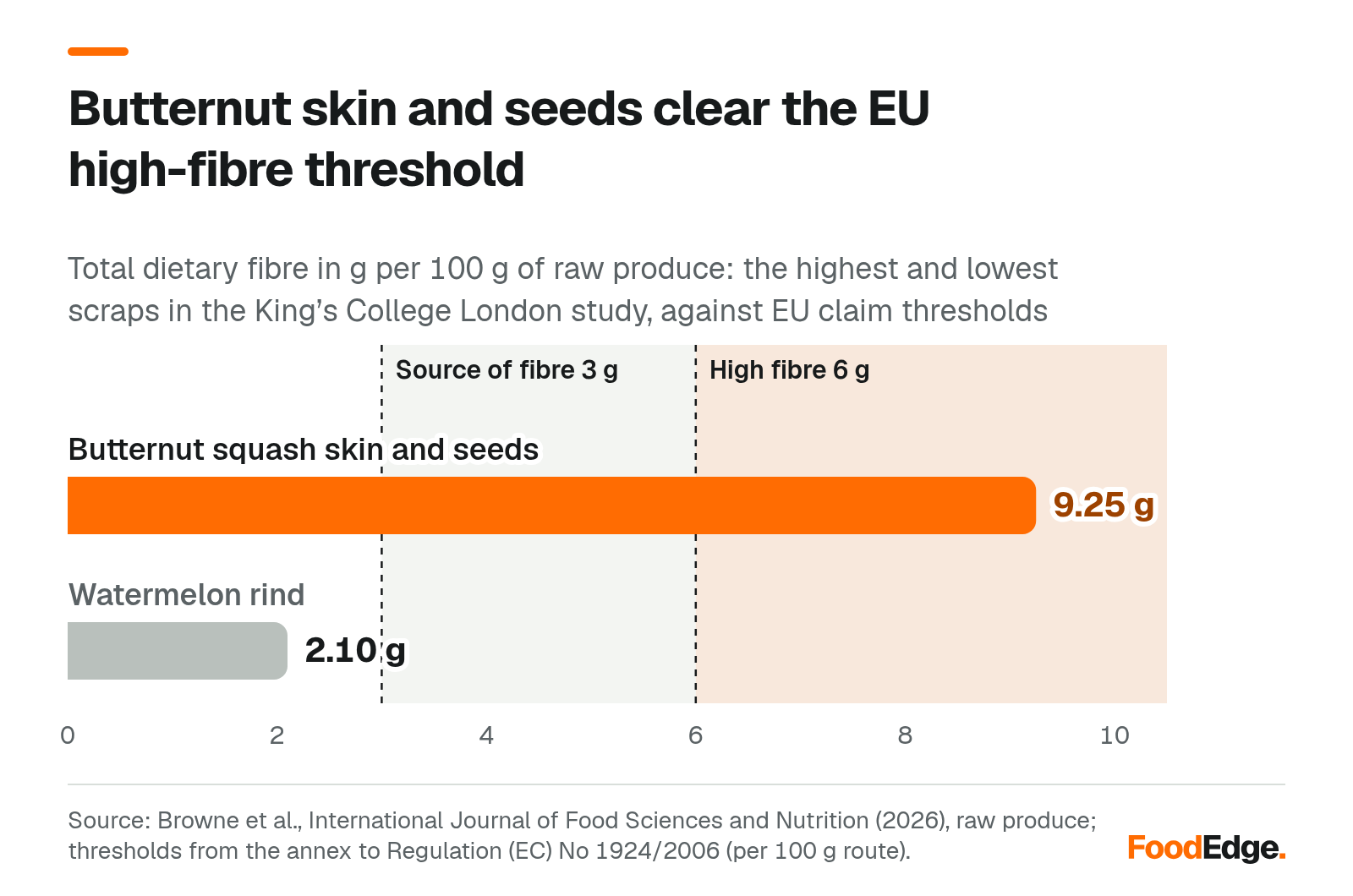
The per-energy route changes the picture for low-calorie scraps. By FoodEdge arithmetic, a material with 2.10 g of fibre per 100 g meets the “source” condition if it supplies no more than 140 kcal per 100 g, and the “high fibre” condition at no more than 70 kcal. The paper’s abstract does not report energy values, so whether watermelon rind qualifies this way is untested. Either route applies to the food as sold, so a scrap’s raw value only matters once it is in a recipe at a known inclusion rate.
“The variation in fibre content between the parts of the food we consume and that most throw away was striking.”
Dr Rachel Gibson, Reader in Nutrition and Dietetics at King’s College London
FoodEdge view: the opportunity sits in the ingredient spec
Our reading is that the strongest use of these numbers is in manufacturing and foodservice, where scraps arrive in volume and recipes are fixed. A soup, sauce or baked product built on butternut skin and seeds could carry a fibre claim if the finished food holds the threshold, which turns a waste stream into a labelled benefit. Drying a scrap into a powder raises fibre per 100 g as water leaves, which helps a formulator reach the threshold at a lower inclusion.
Two checks come before the claim. Peels and skins are the outer surface of the produce, so pesticide and contaminant testing belongs in the specification. A by-product with no significant EU consumption history before 15 May 1997 may also need novel food assessment; dried coffee cherry pulp needed an EU authorisation in 2022 before it could be sold as a food.
Checklist: before a scrap becomes a fibre ingredient
- Measure total dietary fibre and energy in your own material after processing, using the method your claim will rely on.
- Calculate the inclusion rate the finished food needs to meet 3 g or 6 g per 100 g, and the per-100 kcal alternative.
- Test peel and skin fractions for pesticide residues and contaminants against the limits for the source produce.
- Check whether the fraction and process have a documented EU food history before 15 May 1997.
Sources and reporting
- King’s College London: Eating ‘root-to-tip’ could help your health and the planet, 30 October 2026
- Browne G, Nie X, Brooks G, et al. The dietary fibre content of fruit and vegetable kitchen preparation waste and UK consumers’ dietary fibre-related attitudes regarding its consumption. International Journal of Food Sciences and Nutrition, published online 29 October 2026 (CC BY-NC-ND 4.0; abstract via Europe PMC)
- Regulation (EC) No 1924/2006 on nutrition and health claims made on foods, annex
- Commission Implementing Regulation (EU) 2022/47 authorising dried coffee cherry pulp and its infusion as a traditional food from a third country, 13 January 2022
- Regulation (EU) 2015/2283 on novel foods
Reporting note: Desk report on the King’s College London release and the paper’s abstract. The full paper did not load during reporting, so per-item values beyond those published in the release and abstract are not used. Energy thresholds in the sixth paragraph are FoodEdge arithmetic on the EU claim conditions.
AI tools supported source research and drafting during the editorial process.
 FoodEdge Editorial