
EFSA's Appethyl opinion published on 20 October found that the application had not identified the beneficial physiological consequence of changing subjective appetite ratings. In the context of this application, that failure prevented scientific assessment of the causal relationship between the ingredient and a beneficial effect.
The Article 13(5) assessment concerns an aqueous spinach-leaf extract and a proposed satiety and cravings claim. EFSA considered the ingredient sufficiently characterised. The applicant proposed 5 g daily with a meal, with the target population clarified as normal-weight and overweight adults seeking to maintain body weight. That is a proposed condition of use, without an effective-dose finding in this opinion.
Why the assessment stopped
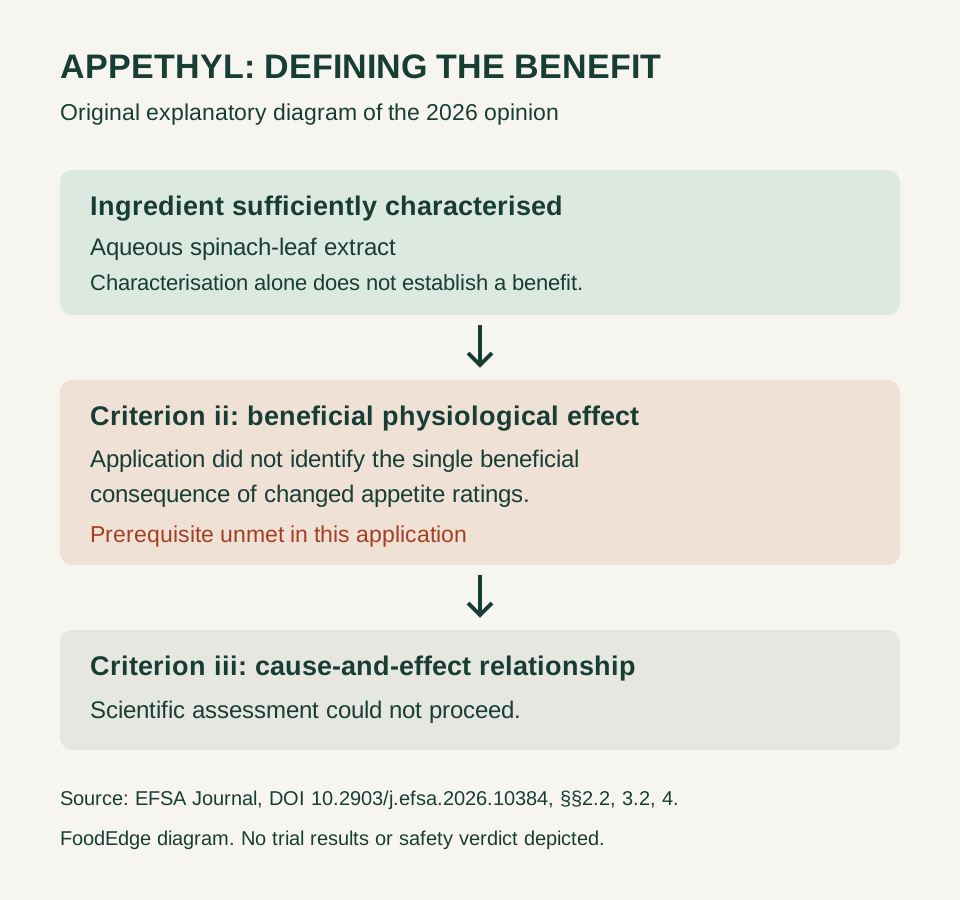
Sections 2.2 and 3.2 explain the sequence. Criterion ii asks whether the claimed effect is a beneficial physiological effect. Satisfying it is a prerequisite for scientific assessment of criterion iii, the cause-and-effect relationship. The application failed to identify the single beneficial physiological consequence of the changed appetite ratings.
A rating can record a change in someone's reported experience. The dossier still needs to say which physiological benefit that change represents. Without that definition, collecting more measurements of the rating does not resolve the question the assessment must address.
The 2026 opinion consequently establishes no causal relationship with a beneficial effect in this application. It supplies no new negative trial or general verdict that Appethyl cannot affect appetite ratings. Its scope also separates the scientific claim assessment from marketing authorisation, safety and foodstuff classification. Current Commission authorisation status has not been checked for this article.
The opinion refers to the same evidence body as an earlier 2023 application concerning body-weight reduction. That earlier question should remain distinct from the 2026 satiety and cravings assessment. FoodEdge has not reviewed the underlying proprietary reports or conducted an independent ingredient-efficacy appraisal.
FoodEdge view: connect the endpoint to the benefit
For an EU nutrition-innovation team preparing a dossier, the useful sequence starts with a defined benefit and target population, followed by an outcome capable of supporting that benefit. A study can measure its chosen endpoint carefully and still leave the intended claim insufficiently specified.
Our reading is that benefit definition belongs in the research brief before trial expenditure is committed. That is a dossier-design implication, with no quantified saving or approval probability established. A distinct application identifying a beneficial physiological outcome would need its own assessment; the present opinion cannot predict that result.
AI tools supported source research and drafting during the editorial process.