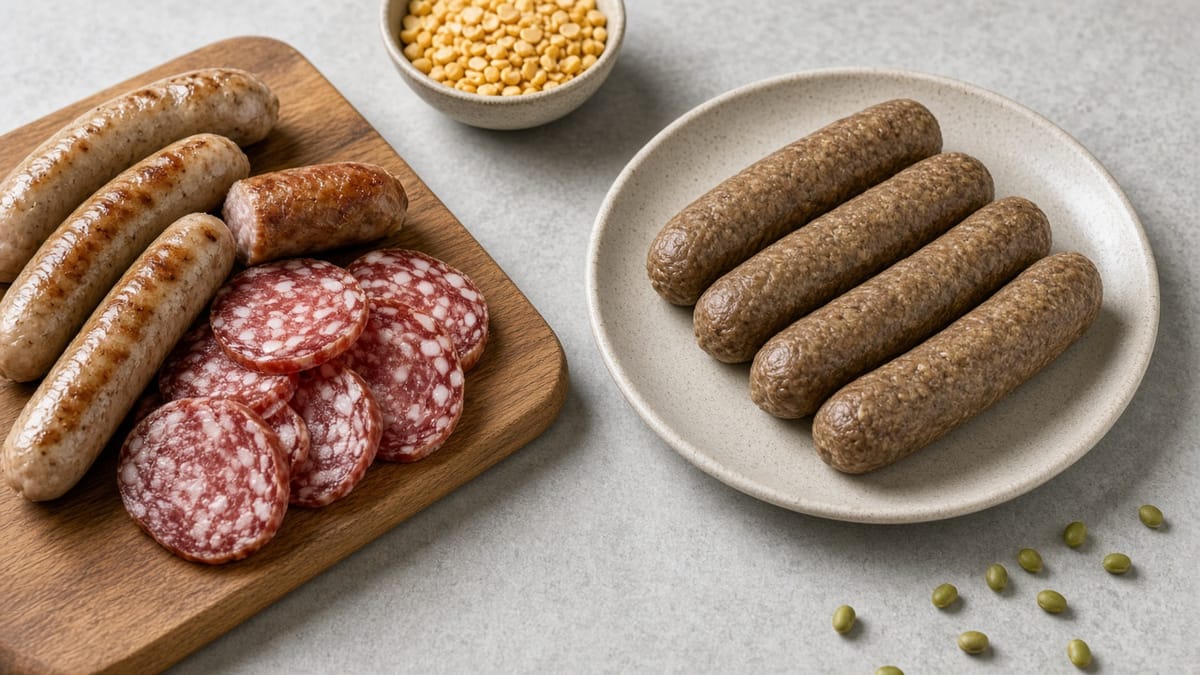
Czech producers of plant-based foods could lose four everyday product names from 1 January 2027. A draft amendment to the Ministry of Agriculture’s meat decree, now in interministerial consultation, reserves párek (frankfurter), klobása (sausage), salám (salami) and šunka (ham) for meat products made from meat or offal. Expats.cz reported the plan on 2 November, after the ČTK news agency collected reactions from the ministry, industry groups and producers on 29 October.
At a glance
- 4product names the draft reserves for meat products: párek, klobása, salám and šunka
- 1 Jan 2027proposed start, with a transition period to 1 January 2028
- 0of the four names appear among the terms the EU reserved for meat in 2026
- CZK 50mtop fine for misleading consumers cited by the Czech alternative-protein chamber
Draft amendment to decree 69/2016 Coll. (VeKLEP file KORNDZ29H2T7), as summarised by namireno.cz; ČTK, 29 October 2026; Regulation (EU) 2026/1739.
What the draft changes
The draft amends decree No. 69/2016 Coll., which sets requirements for meat, meat products and fishery products. It ties each of the four names to meat products formed into their customary shape and sets minimum composition values in a new table in annex 6. It also defines names for fish fillets and for egg products such as yolk, white and melanž, and requires packed minced meat to be kept at 4 °C or below. Goods already on the market could be sold until stocks run out. The draft cites the EU’s new meat-names regulation and the 2024 Protéines France judgment, and has to be notified to the European Commission under the EU technical-regulation procedure before adoption. The file was last updated on 20 October.
The ministry told ČTK that the draft sets requirements for existing names, bans no word as such and was prepared with producers. Agriculture minister Martin Šebestyán (SPD) said it gives producers the chance to stand out with original names. The Czech Food Federation, through Marek Zemánek, supports the change, and the Agrarian Chamber said on 15 October that it would bring consumers more information and producers more legal certainty. An earlier proposal was withdrawn under the previous minister, Marek Výborný.
The route the CJEU left open
In Protéines France (C-438/23), decided on 4 October 2024, the EU Court of Justice held that a member state without a legal name in place cannot generally ban customary or descriptive meat terms for foods containing plant protein. It also ruled out national thresholds for plant-protein content. A member state may, however, adopt a legal name: a name reserved by law for a food that meets set requirements. The Czech draft uses that second branch. Each of the four words becomes a legal name with a composition table, and a product that fails the table loses the word.
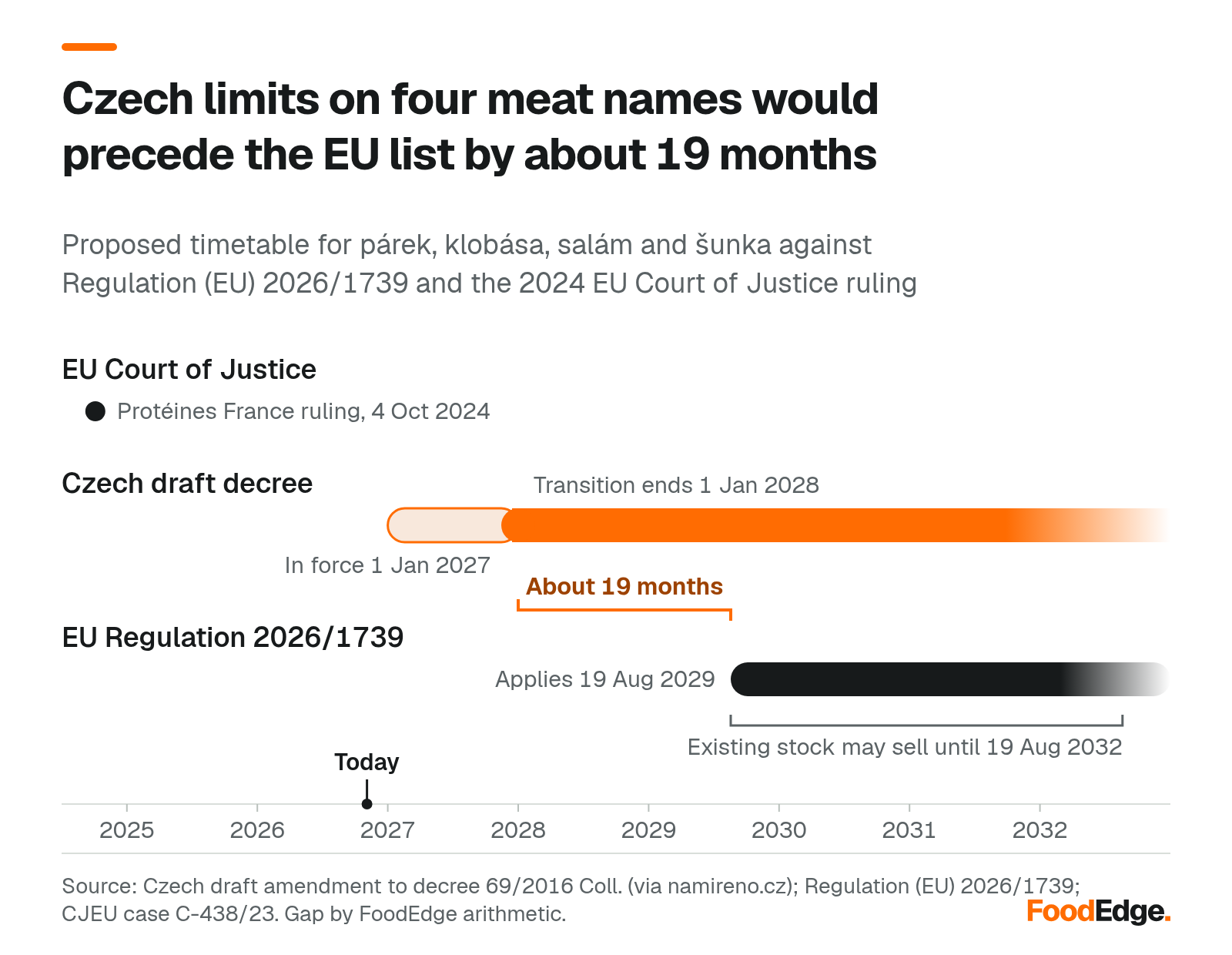
Regulation (EU) 2026/1739 amends the EU’s common market organisation rules to define “meat” and reserve 31 terms, among them steak, bacon, chicken and breast, for products derived from meat; foods made from cell and tissue cultures cannot use them either. Burger and sausage are not on the list, the UK government’s explanatory memorandum notes, and neither are frankfurter, salami or ham. The EU rules apply from 19 August 2029, and products already labelled may be sold until 19 August 2032. On the draft’s timetable, Czech restrictions on four terms the EU left open would be fully in force about 19 months before the EU list applies.
Who pays for the change
David Hůlka of the Czech Chamber of Alternative Proteins (ČKAP) told ČTK that firms face renaming, new packaging and fines of up to CZK 50 million for misleading consumers under the food act. Lada Gracová of Salve Natura, which has sold a smoked plant-based klobása for more than 20 years, said the company’s main concern is whether customers will still find it. Jana Pavelková of ProVeg Česko used “plant-based cylinder” (rostlinný váleček) to illustrate the names producers might be left with.
“Nobody standing at the shelf is wondering whether a soy sausage or lentil meatloaf contains meat. It says so on the packaging.”
Jana Pavelková, ProVeg Česko, to ČTK (FoodEdge translation)
The draft also raises a single-market question. Article 17 of Regulation (EU) No 1169/2011 lets a food keep the name under which it is lawfully made and sold in its member state of production, with extra description where needed, and allows the host country to refuse that name only in exceptional cases where the food differs so much in composition or manufacture that consumers would be misled. A plant-based sausage made in Germany or Poland and sold in Czechia sits on that line. Under Directive (EU) 2015/1535, the Commission and other member states get a standstill period of at least three months to comment once the draft is notified.
FoodEdge view: composition tables now decide the name
Our reading is that Czechia has taken the narrow lane the court left open, a legal name with a recipe attached. If the draft passes, the argument moves from the words to the annex, because the minimum values will decide which hybrid products, part meat and part plant protein, can still say klobása or šunka. Fully plant-based products would lose the four names in Czech whatever their formulation.
For brands that sell across the EU, the near-term cost is a separate Czech naming system for at least 19 months before the EU list applies, plus a test of how far Article 17 protects products named elsewhere. The comments filed in the notification procedure will show whether the Commission or other member states see a barrier to trade.
Checklist: before the Czech names change
List every product sold in Czechia that uses párek, klobása, salám or šunka, including the Czech line on multilingual packs.Check hybrid meat products against the annex 6 minimum values once they are published.Cost one Czech label change for the 1 January 2028 deadline and a second for the EU terms that apply from 19 August 2029.For products made in another member state, take legal advice on Article 17 of Regulation (EU) No 1169/2011, and watch the TRIS database for the Czech notification and its comment deadline.
Sources and reporting
- Ministry of Agriculture: draft amendment to decree No. 69/2016 Coll. (VeKLEP file KORNDZ29H2T7), updated 20 October 2026
- Namířeno.cz: summary of VeKLEP file KORNDZ29H2T7, checked 3 November 2026
- ČTK (České noviny): reactions to the draft meat decree, 29 October 2026
- Expats.cz: No meat, no sausage? Czech proposal puts plant-based labels in question, 2 November 2026
- Agrární komora ČR: release on the meat decree amendment, 15 October 2026
- Regulation (EU) 2026/1739 amending Regulation (EU) No 1308/2013 (EUR-Lex)
- Latvian Ministry of Agriculture: EU introduces clearer rules on the use of meat-related product names
- UK Government explanatory memorandum on Regulation (EU) 2026/1739 (Northern Ireland Assembly)
- Court of Justice of the EU: press release on case C-438/23, Protéines France, 4 October 2024; judgment
- Regulation (EU) No 1169/2011 on food information to consumers, Article 17
- Directive (EU) 2015/1535 on technical regulations (TRIS), Article 6
Reporting note: Desk report on a Czech draft decree, Czech news-agency reporting and EU legal texts. Quotations from Czech sources are FoodEdge translations. Not legal advice.
AI tools supported source research and drafting during the editorial process.
 FoodEdge Editorial