

Beyond Meat's accounts give investors a reason to ask hard questions about its cost structure. They do not give them permission to call every dollar of overhead a dollar of marketing, or to diagnose a sensory problem from a profit and loss statement.
In 2024, selling, general and administrative expenses were 52.0 percent of net revenues, while research and development was 8.6 percent. In 2025, those ratios were 79.0 percent and 8.4 percent. The comparison comes from the company's FY2025 Form 10-K. The 2025 SG&A measure excludes the separately presented loss on the write-down of assets held for sale.
Those are large differences. But SG&A includes selling, administration, legal costs and other expenses as well as marketing. The filing identifies a USD 38.9 million litigation-related accrual among the reasons for its 2025 increase. It also says advertising expense fell. Describing the ratio as marketing versus science would misstate the evidence.
The more useful question is what a company must be capable of doing when the next improvement has to happen in the product itself. Can it measure the sensory problem? Can it connect that problem to structure and process? Can it reproduce the improvement at scale, at a price the consumer will accept?
My argument is that the next generation of plant-based businesses needs texture capability at the centre of the company. That is a strategic judgement, not a claim that a spending ratio predicts the winner or that marketing has no role.
The next great plant-based company may look less like a campaign looking for a product, and more like a texture lab with a P&L.
The myth: the category's problems came entirely from outside
There are several convenient explanations for a difficult plant-based market. Consumers became sceptical. The price premium was too high. Media coverage changed. Health priorities shifted. Each may matter in a particular market, product or period. None should be accepted as the whole explanation without evidence.
The opposite simplification is equally unhelpful: plant-based stalled because every first-generation company was a brand without technology. That ignores real product development and treats different businesses as if they shared one organisational history.
I use plant-based 1.0 and 2.0 here as editorial shorthand. The first describes a business that relies heavily on distribution and brand expansion while leaving its central product problem unresolved. The second describes a business that makes the work of resolving that problem a strategic priority. These are analytical models, not audited cohorts of companies.
The distinction is useful when it prompts a practical question. Does the organisation have the people, experimental access, decision rights and capital to improve the eating experience? It becomes misleading when it substitutes a label for examining those things.
One-minute brief
Innovators: technical capability should have influence over the roadmap and access to realistic product tests. Ask who decides whether a change works, what evidence they use and how quickly the next experiment can happen.
Founders: a reformulation can be substantial. Its credibility rests on the change in performance, the customer evidence and its manufacturability. Test those outcomes before assuming that the next recipe or campaign will restore growth.
Investors: examine the development organisation alongside brand and channel metrics. Ask for named responsibilities, equipment access, sensory methods and a path from laboratory result to repeat purchase. A PhD count is not a substitute for that evidence.
Read the capital allocation carefully
The Beyond Meat figures show an imbalance between two accounting categories. They do not isolate discretionary brand spending or reveal how productive each development dollar was. An overhead ratio can rise because costs rise, revenues fall or both. An R&D ratio can move because the denominator changes even when the research programme does not expand.
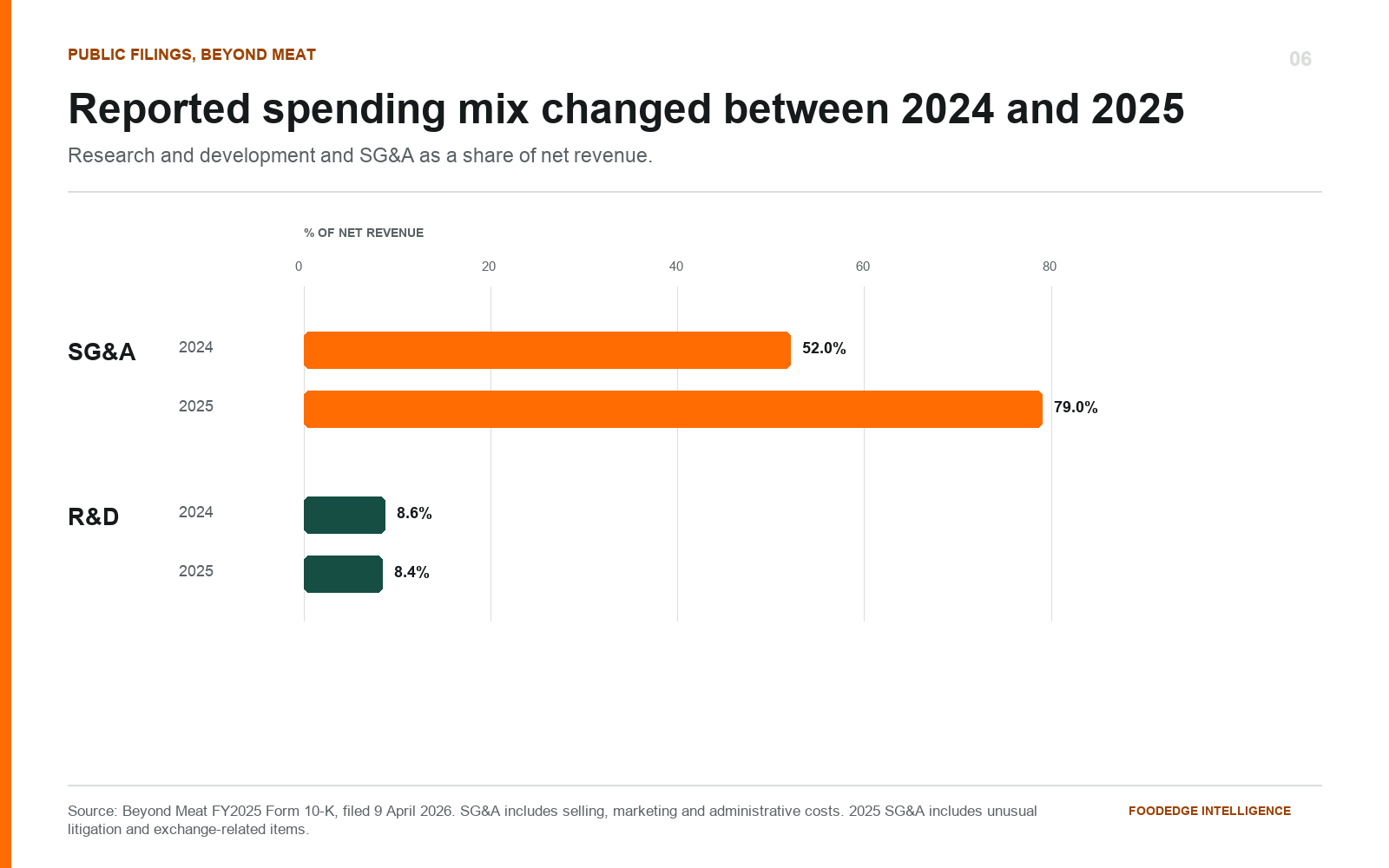
The comparison is therefore a starting point for questions. What activities sit in each line? Which costs are recurring? What proportion supports the next product, and what proportion supports an existing operating structure? Does a lower development budget reflect efficiency, a completed programme, a different accounting treatment or a loss of capability?
Beyond Meat's report describes R&D as including staff, scale-up work, relevant depreciation and facilities. Some valuable product work can also occur through suppliers and manufacturing operations. Counting only a headline percentage may miss the way a company actually develops and industrialises food.
That does not make the allocation irrelevant. It makes the interpretation more demanding. If a company says product performance is its route back to growth, investors should ask which funded experiments address the limiting performance problem. They should then ask what result would change the commercial plan.
Oatly provides a separate comparison, not a second observation of the same meat-texture problem. Its FY2025 Form 20-F reports R&D expenses of USD 18.6 million, or 2.2 percent of revenue, compared with USD 30.1 million, or 3.7 percent, in 2024. The company mainly attributes the decrease to expenses related to a North American product launch issue in the prior year. Oat drinks have different functional requirements from burgers or whole cuts. These figures cannot establish a common sensory failure or prove that either business lacks meaningful technology.
There is no universal R&D percentage that makes a food company a technology company. Comparing it with pharmaceutical research intensity without adjusting for development models, accounting and stage creates a false benchmark. The question is whether the resources match the work required to create and sustain an advantage.
The same discipline applies to private companies. Funding announcements are not R&D expenditure accounts. A new factory does not disclose the headcount mix, and a technical founder does not establish the productivity of a whole research organisation. I cannot support the claim that a clearly defined second-generation cohort has reversed the first generation's marketing-to-R&D ratio.
Three forces that make texture a business question
1. Trial and repeat purchase are different jobs
Brand, availability, curiosity and values can bring a consumer to a first purchase. The eating experience can influence whether that person returns. That is a commercial mechanism worth testing, rather than an excuse to stereotype early adopters as people who did not care about food.
Animal welfare, climate, health, price and convenience can matter to the same person at the same time. It is unreasonable to assume that an early buyer accepted an arbitrary thirty percent sensory deficit, or that every later buyer abandoned ethical concerns. The mixture of motivations needs research in the intended market.
Consider an illustrative scenario, not a reported retail dataset. A new burger gains trial through a promotion and prominent placement. Consumers like the flavour, but some find it dry after a normal home cooking time. The team adds advertising to recruit more trialists. Sales can grow temporarily even if the same eating problem limits repeat purchase.
In that scenario, marketing is doing the job assigned to it. The error is asking it to solve a product problem that has not been measured and addressed. A useful diagnosis would compare household preparation, perceived dryness, repurchase and price acceptance. It would not simply move the budget from one department to another.
The management implication is to make trial and retention separate questions. Know who buys once, who returns, at what price and after which eating experience. Then decide whether the next pound belongs in product development, availability, communication or a combination of those activities.
2. Sensory quality needs a defined benchmark
Texture is not one number. A product may be too firm at the first bite, too pasty during chewing, insufficiently juicy or unconvincing after cooling. It may perform well freshly cooked in the laboratory and poorly after the customer's normal storage and preparation.
The research needs to distinguish these problems. Instrumental measurements can help explain structure and consistency. Trained sensory work can describe differences. Consumer testing can show whether the intended eater likes the result. None of those steps automatically replaces the others.
NECTAR's Taste of the Industry 2025 reports blind sensory testing of 122 plant-based meat products across 14 categories with 2,684 omnivores in American restaurant settings. Its public description includes category comparisons for flavour, texture, appearance and similarity, with animal benchmarks. That provides a useful starting point for product-specific investigation.
It does not, by itself, establish that texture has failed to improve since 2023, that it is the main cause of non-repeat everywhere, or that every plant-based category has the same deficit. A longitudinal claim needs comparable products, methods and sampling over time. A statement about purchasing needs purchasing evidence.
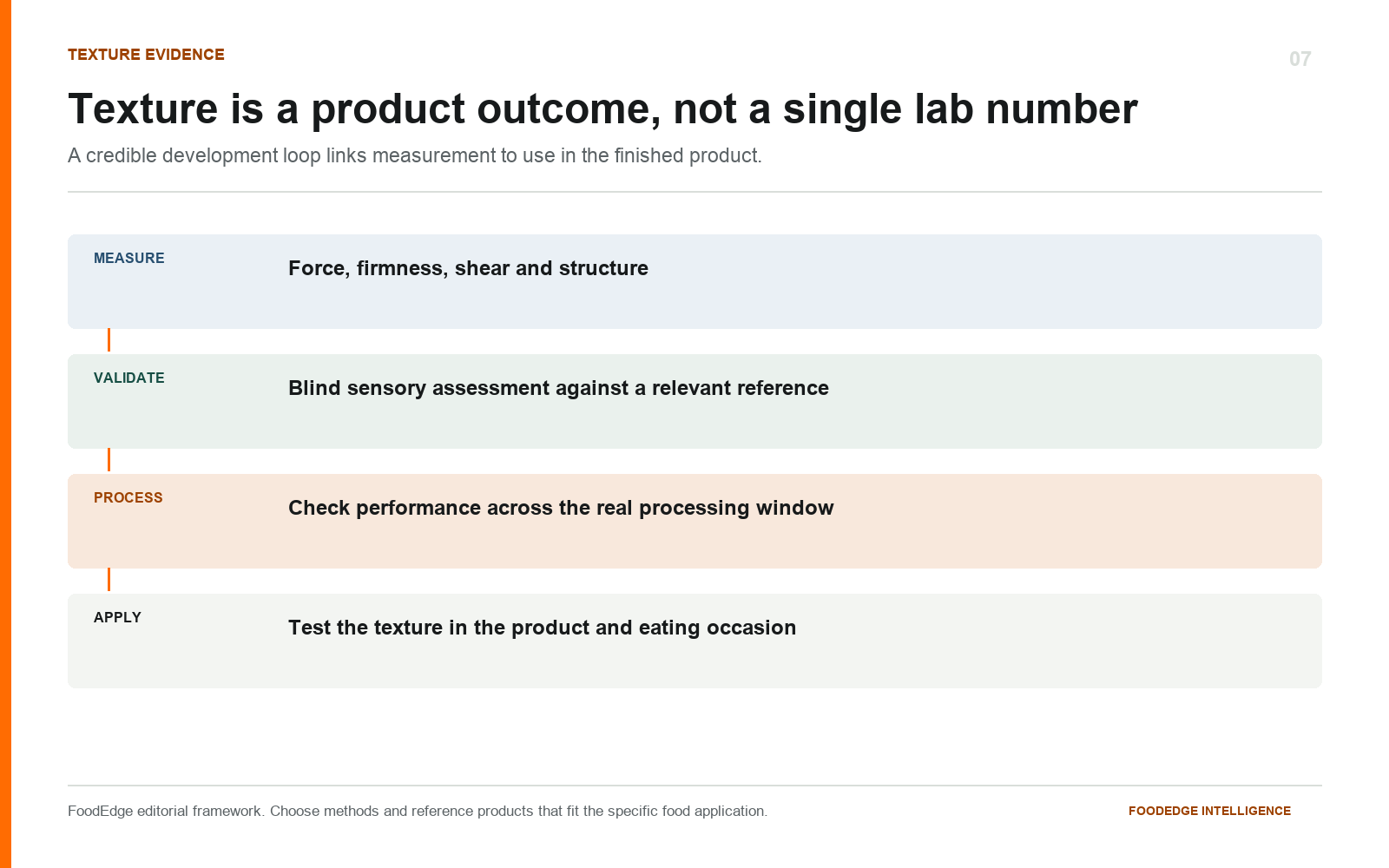
The distinction has practical value. A company does not need to solve every possible sensory difference before it can build a business. It needs to know which differences its intended consumers notice, which affect preference and which they will trade against price, convenience or nutrition.
Define the benchmark before claiming parity. Is the target a leading animal product, an average category product, a particular cooking method or a specific use such as a sandwich filling? State the question, test conditions, sample and uncertainty. A favourable result against one comparator does not establish equivalence to an entire category.
The next commercial experiment should follow from that definition. If the change improves a blinded test but requires a cooking method shoppers will not use, the product still has work to do. If the preferred version is too expensive to make, the company has identified a promising formulation rather than a finished market proposition.
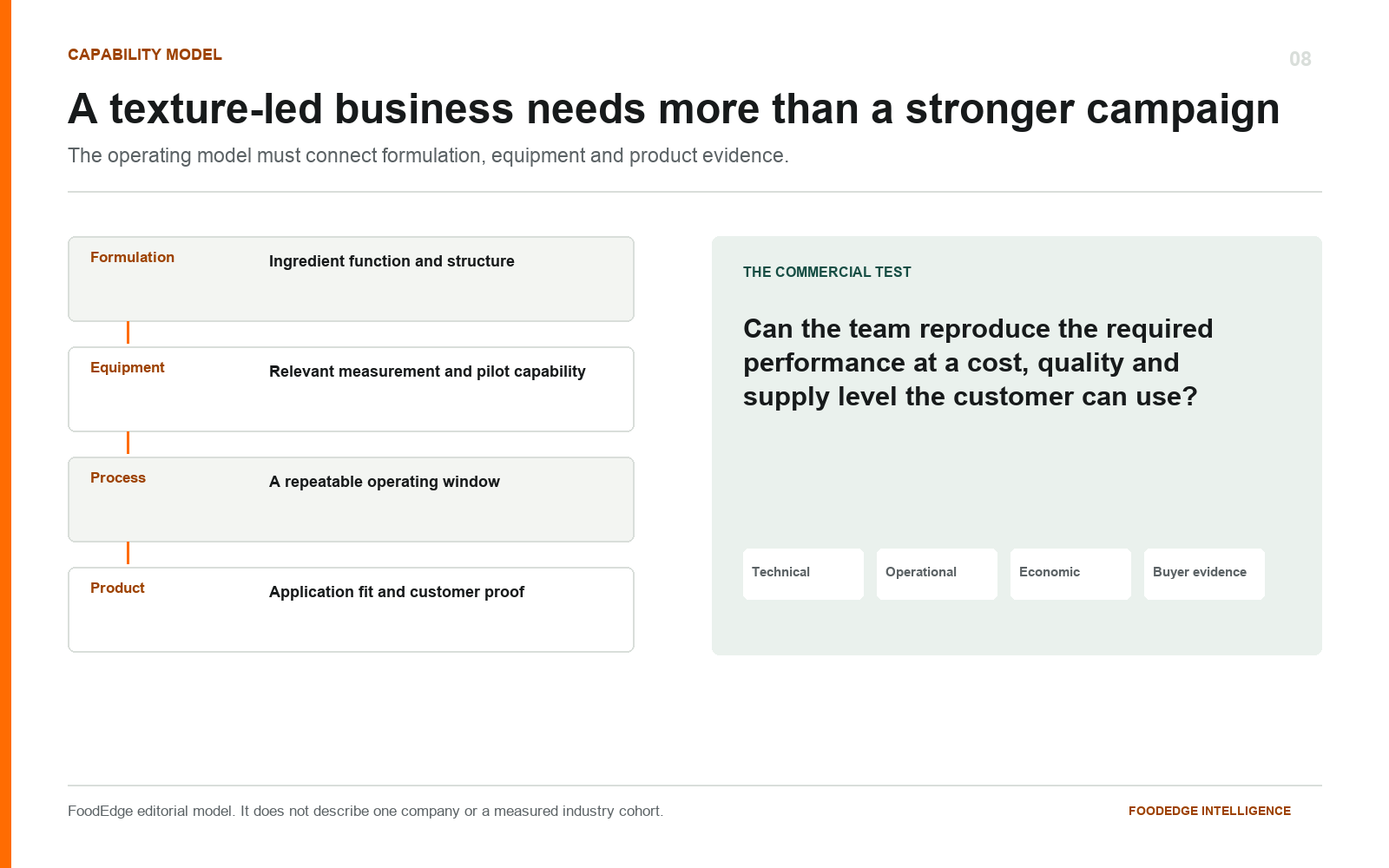
3. Capability is an operating system
You cannot assume that hiring two food scientists will repair an organisation that cannot act on their findings. The issue is how technical work connects to decisions, resources and production. Equally, you cannot infer that a company is incapable of change because it already has a large commercial team.
A texture programme may need expertise in food science, materials, process engineering, formulation and sensory research. A mycelium product adds different biological questions from an extruded pea-protein product. The equipment should follow the problem, rather than a universal shopping list attached to a second-generation label.
Extruders, rheometers, texture analysers, pilot cooking systems and fermentation access can matter. Owning all of them is not a prerequisite. Shared facilities, universities, suppliers and contract development partners may provide effective access. The questions are whether the team can run the right work reliably, protect relevant knowledge and receive results in time to make decisions.
The governance test is straightforward. Can a technical result stop a launch or redirect a formulation budget? Can the commercial team explain what improvement a customer values? Can manufacturing reproduce the result under realistic tolerances? If those functions work in separate loops, another job title may not close the gap.
There is no fixed 18-36 month formulation cycle or 18-24 month organisational rebuild. The time depends on the intervention, ingredient availability, equipment, validation, shelf life and the organisation's starting point. Some changes are fast. Others depend on new processes and substantial capital. A credible plan identifies the critical path rather than borrowing a generic duration.
Two cases, without declaring a winner
Beyond Meat: ask what a reformulation changed
Beyond Meat helped make plant-based meat a mainstream commercial proposition. Its product development should be assessed on evidence rather than dismissed as cosmetic because the company later faced difficulties.
A change in fat system, protein blend, processing or nutrition can be technically material. Whether consumers notice and prefer it is a separate question. Whether it improves margins or demand is another. Calling a reformulation a technical reset does not prove those outcomes, but calling it cosmetic without comparative evidence is no more rigorous.
The public accounts can identify costs, revenues and risks. They cannot tell us that the company never had a sufficiently deep texture team, that all its technical hiring was inadequate, or that a particular board composition caused a product to miss a sensory target. Those claims require evidence about the organisation and the product.
An investor can still ask a pointed question: what must the next product iteration accomplish that the previous one did not, and how will management know? The answer should specify a consumer problem, a measurable outcome and a manufacturing consequence. A launch announcement alone is not the answer.
MyForest Foods: structure can begin in the biology
MyForest Foods provides a useful example of a different route to structure. The company describes growing oyster mushroom mycelium as intact sheets, then slicing and seasoning them for MyBacon. It links that work to Ecovative's AirMycelium technology. These are company descriptions of the process, not an independent proof of parity with pork bacon.
Its July 2026 account of its Pennsylvania farm partnership describes adapting existing mushroom-growing rooms and equipment for the crop. That adds an operational detail missing from a simple story about a proprietary factory: technical capability can include transferring a process into an experienced production partner's infrastructure.
The company and Ecovative also announced funding in March 2025 that would support a new production and packaging line and a Food Science Lab. That is evidence of announced investment intent. It does not disclose an audited R&D-to-marketing ratio, prove all announced projects were completed or establish profitable economics.
The interesting technical proposition is that some structure is grown before formulation. It opens a different set of development questions: how consistent is the sheet, how does it take up seasoning, what happens during cooking, and how does the final product perform after distribution? It does not show that mycelium inevitably beats extrusion. Different approaches should be compared in the application they intend to serve.
Nor should the existence of a technically interesting company be treated as proof that a new cohort has solved the commercial problem. Manufacturing reliability, consumer preference, availability, price and cash remain part of the test. Texture capability is a necessary question for this strategy, not a certificate of success.
For innovators: examine the decision rights
When evaluating an offer or an internal role, interview the company as carefully as it interviews you. Ask where technical decisions sit, how the team receives consumer feedback and which evidence would change the next launch decision. A promise that the company values science needs an operating mechanism.
Ask who owns the sensory programme. Can the team commission work with the intended consumers? Does it have access to realistic process trials? Who decides when laboratory improvement is sufficient for an industrial run? The answers show whether technical work is connected to the business or used mainly to support a story.
Technical representation in senior decisions can help. It need not mean a mandatory board seat or a particular academic credential. Experienced operators may bring judgement that a publication count does not capture. What matters is that somebody can challenge a technical assumption and that the challenge receives a serious hearing.
Watch the next hires and the resources behind them. A technical title without experimental time, pilot access or production support is a weak signal. A small team with strong partners and clear authority may do more than a larger department whose results cannot change the plan.
The ambition is a company in which product development and commercial understanding sharpen each other. Scientists should know the use case they are solving; commercial teams should know what the product can credibly promise. Neither function can delegate that relationship to the other.
For founders: run a capability audit
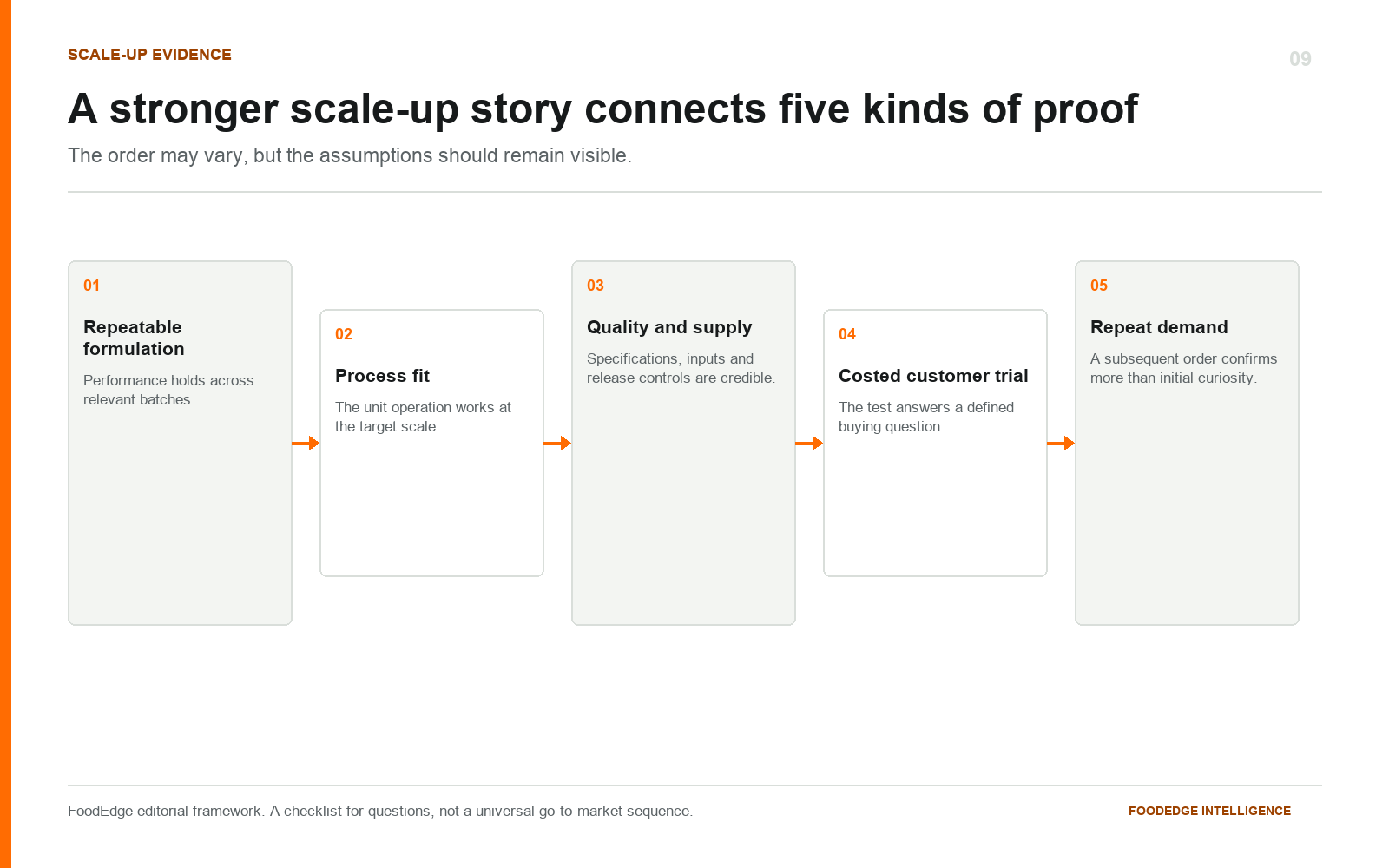
Start with the product problem. Name the sensory attribute that most needs improvement, the consumer group and the use occasion. If the team cannot agree on those, the first task is diagnosis. Buying equipment before choosing the question can be another form of avoiding a decision.
Then map the capabilities. Who can formulate the relevant experiment? Who can run it? Who can interpret the result? Who can translate it to production? Include external partners and identify the dependencies you do not control. A headcount percentage is a poor substitute for this map.
Next, examine the equipment and access budget. Does it fund the critical experiment, its repetition and a realistic manufacturing trial? Is capacity actually reserved, or simply available in theory? Include sample preparation, analytical work, shelf life and sensory evaluation where the decision requires them.
Finally, examine the authority to act. If results show that the chosen product architecture cannot achieve the required performance at an acceptable cost, can the company change course? A development team that can only optimise within an unchangeable marketing promise may be solving the wrong problem efficiently.
The response does not have to be a wholesale rebuild. It might be a narrower product brief, a different manufacturing partner, better sensory work or a change in launch timing. A deeper redesign may be necessary, but it should follow the diagnosis. There is no evidence-based rule that most existing companies cannot adapt.
Set the next funding milestone around a decision, not just an activity. Completing ten trials is useful only if those trials tell you whether to continue, change the process or stop. Put the cost of that learning beside the cost of expanding distribution with the current product.
Write the commercial consequence into the brief. If the team reduces dryness, will that change preference in the intended meal? If it makes a firmer product, does that improve enjoyment or merely move an instrument reading? If it improves consistency, does it reduce customer complaints or production rejects? An experimental result should have a route to value that can be checked.
Protect the distinction between a research milestone and a launch gate. Finding a promising structure is progress. Showing that it survives storage, cooking and repeated manufacture is a different achievement. A useful development plan has room for both, and does not let a persuasive tasting compress the work between them.
This is also where the commercial team earns its place. It can identify which preparation method matters, what the retailer needs, how shoppers understand the proposition and which price is realistic. Treating marketing as the enemy of science would weaken that information flow. The organisational change I am arguing for gives the product problem authority while keeping the consumer and the route to market in view.
For investors: follow the evidence into the product
Four questions help test a texture-first pitch.
Who owns the technical problem? Ask for relevant capabilities and named responsibilities. Food scientists, engineers, sensory specialists and production staff may all contribute. The degree on a CV matters less than the team's ability to run and interpret the work.
What access does the team actually have? Ask about pilot equipment, analytical methods, sensory recruitment and production trials. Distinguish equipment already usable from access being negotiated and capex dependent on the next round. Consider a credible external arrangement alongside ownership.
What has improved? Ask for the comparator, preparation method, sample, test design and result. Include negative or mixed results. A single favourable tasting is a reason to investigate further, not a basis for declaring universal sensory parity.
Will the improvement survive commercial conditions? Ask about repeated lots, shelf life, cooking variability, yield and cost. Then examine whether real customers value the result enough to buy again. A higher research budget can support that work; it cannot stand in for its outcome.
Financial statements remain useful. They can test whether management's stated priorities fit its reported allocation and whether the company has room to fund the next stage. They should be read alongside product evidence, operating data and customer behaviour. A spending ratio does not contain the whole company.
If you doubled the resources devoted to the hardest product problem tomorrow, would the organisation know what experiment to run and what decision the result would change? That is a more useful test than whether the deck calls the business plant-based 2.0.
Sources and editorial basis
This is a revised version of the author's original essay, first published on 30 April 2026. Financial, company and sensory-research sources were checked on 16 October 2026. The spending chart reproduces reported ratios with their accounting limits. The other diagrams are editorial models. Company descriptions remain attributed; scenarios and recommendations are author analysis. No cross-company sensory-parity or repeat-purchase dataset is claimed here.


