Summary: science-based ventures are moving their protected centre from the factory to the judgement core
Design. A conceptual study built as a theory adaptation: classical theories of the firm and of innovation management are re-examined through recent evidence on AI capability, capacity markets, regulation and venture finance. Inference is abductive: from a set of facts that existing theory explains poorly, to the simplest explanation that would make them expected, then to propositions that could prove that explanation wrong. Every empirical claim is graded by the strength of its evidence.
Findings. Four claims follow.
1. The protected centre of the science-based venture is moving from the technical core, the owned factory that classical organisation theory placed at the heart of the firm, to a judgement core: the decisions that cannot be cheaply undone, together with the people competent to make them and accountable for them.
2. Around that core, work is best arranged in three orbits of AI agents distinguished by the kind of knowing they do (experimentation, keeping state, coordination), with physical capacity and specialist expertise rented at the edge. I call this configuration the Copernican Firm, set against the Ptolemaic Firm organised around owned production.
3. The speed of such a firm is limited by the slowest of three clocks (data-rich capacity, regulatory time and capital backed by real orders); faster agents raise it only when that clock moves.
4. When the factory is rented, value tends to flow to whoever owns the data the factory produces.
Implications. For founders, investors, corporate innovation units and contract manufacturers, the theory yields five measurable indicators (judgement ratio, loop velocity, memory share, gate latency and belt ratio), five recognisable failure modes and six propositions that existing data can begin to test.
Status. This is a theory proposed for testing. The evidence assembled here makes it plausible; it does not yet make it proven.
1. Introduction: four observations that the classical theory of the firm explains poorly
Consider a decision that a growing number of food biotech founders now face. A team with a promising fungal protein has raised its seed round. A landlord offers a lease on a 5,000-litre fermentation suite that the team would run on its own schedule and could show investors as a tangible asset. For the same money, a contract manufacturer offers three rented production runs over twelve months, with a contract clause giving the start-up full rights to every data point those runs produce. Twenty years of management practice says take the lease. This essay argues that, for most such teams today, the second option is the better choice, and that the reasons tell us something general about how science-based ventures are changing.
Twenty years of management practice says take the lease. This essay argues that, for most such teams today, the second option is the better choice
The classical answer has a long pedigree. James D. Thompson's Organizations in Action (1967) placed a technical core, the production machinery that turns inputs into outputs, at the protected centre of every organisation, with buffering and boundary-spanning units arranged around it. Transaction-cost economics, from Ronald Coase (1937) to Oliver Williamson (1985), added that assets specific to one relationship should be owned, because renting them invites hold-up. A science-based venture with a proprietary process would, on both accounts, be expected to own its production as early as it could.
Four observations from the present decade sit uneasily with that expectation.
- Owned steel has become a frequent companion of failure. Fermentation ventures that raised hundreds of millions of US dollars, including Meati (about USD 400 million raised, with its own production facility; High, 2025) and Motif FoodWorks (USD 345 million by mid-2021; Watson, 2024), closed or were restructured between 2024 and 2025, while venture funding for fermentation fell from USD 632 million in 2024 to USD 357 million in 2025 (Good Food Institute, 2026).
- The cost of coordination is falling at an unusual speed. The length of task that frontier AI agents can complete with 50% reliability has doubled roughly every seven months since 2019, and roughly every 4.3 months since 2023 (Kwa et al., 2025; METR, 2026).
- Capacity can be rented, but it is scarce and rarely rich in data. The global food fermentation capacity available to start-ups is estimated at a lower bound of about 16 million litres, with an investment of more than USD 250 billion needed by 2050 (Good Food Institute & Integration Consulting, 2023; Aminetzah et al., 2025).
- Start-ups are getting smaller before agents have even matured. The average seed-stage company on Carta had 6.2 equity-holding employees in 2025, down from 10.3 in 2021 (Carta, 2025; Vidra, 2025).
None of these facts refutes Thompson or Williamson. Together, however, they suggest that something in the conditions those theories assumed has changed, and that the protected centre of the science-based venture may be moving.
Research questions
The essay addresses three questions.
- RQ1. What should a science-based venture keep inside its boundary when coordination is cheap and production capacity can be rented?
- RQ2. How should AI agents be arranged in relation to the human decisions that carry the venture's risk?
- RQ3. Under what conditions does renting capacity create value for the venture rather than leak it to the owner of the capacity?
Contribution and structure
The contribution is a theory, offered for testing, that connects the theory of the firm with three active conversations in innovation management and entrepreneurship: how new ventures in deep technology organise under uncertainty, how open and outsourced models of innovation distribute value, and how human judgement and AI are being combined inside organisations.
Section 2 sets out the research design and the logic of inference. Section 3 assembles the evidence and grades its strength. Section 4 places the argument within established theory. Section 5 presents the theory itself, Section 6 its propositions, and Section 7 its practical implications. Section 8 states where the theory stops and how it could be tested.
2. Research design: a theory adaptation built by abduction and exposed to falsification
2.1 Type of study
This is a conceptual study. Following Elina Jaakkola's (2020) classification of conceptual designs, it is a theory adaptation: it takes an established body of theory, the domain theory, and revises it with the help of other theories, the method theories, because new conditions have weakened one of its assumptions.
- Domain theory: Thompson's protected technical core, together with transaction-cost accounts of the boundaries of the firm (Coase, 1937; Williamson, 1985).
- Method theories: the complementarity of prediction and judgement (Agrawal, Gans and Goldfarb, 2018); types and levels of automation (Parasuraman, Sheridan and Wickens, 2000); profiting from innovation through complementary assets (Teece, 1986); modular production networks (Sturgeon, 2002); and the logic of binding constraints (Amdahl's law: Amdahl, 1967; and Goldratt's theory of constraints: Goldratt and Cox, 1984).
2.2 Logic of inference
The argument proceeds in three steps, each with a different logic.
- Abduction. Following Charles Sanders Peirce, and the more recent account of theory building by abduction from Sætre and Van de Ven (2021), the essay starts from observations that existing theory explains poorly (Section 1) and asks which explanation, if true, would make them unsurprising. The judgement core is that candidate explanation.
- Deduction. From the candidate explanation, specific propositions are derived, each with an explicit mechanism (Section 6).
- Exposure to refutation. For each proposition, the essay states in advance which observation would count against it, in the spirit of Karl Popper's (1959) requirement that a theory forbid something.
To stress-test the explanation before it reached readers, I used a device that Karl Weick (1989) would recognise as disciplined imagination: a structured adversarial review in which the argument was attacked from six professional perspectives I have held myself (chef, biologist, corporate operator, portfolio director, European Commission evaluator and forensic analyst of failed ventures). This is a form of internal red-teaming. It improves an argument; it does not replace independent review, which the theory still needs.
2.3 Sources and grading of evidence
The essay weights evidence by its source. It uses four tiers and grades every central claim as strong, moderate or speculative.
| Tier | Type of source | Examples used here | How it is used |
|---|---|---|---|
| A | Peer-reviewed studies and primary measurement | Brynjolfsson, Li and Raymond (2025); Singh et al. (2025); the Stanford Virtual Biotech study (Zhang et al., 2026); METR capability measurements (Kwa et al., 2025; METR, 2026) | Mechanisms and effect sizes |
| B | Systematic industry data | Good Food Institute capacity census and investment data (Good Food Institute & Integration Consulting, 2023; Good Food Institute, 2026); Carta founder and headcount data (Carta, 2025; Walker & Dowd, 2026); TrendForce foundry shares (Focus Taiwan, 2026) | Scale and trends of the phenomenon |
| C | Consultancy and vendor analysis | McKinsey (Aminetzah et al., 2025) on fermented proteins; market-size forecasts | Orders of magnitude only, never as findings |
| D | Company statements and press | Funding announcements, founder interviews, headcount estimates | Illustration only |
2.4 Choice of context
Food biotech, and precision and biomass fermentation in particular, serves as a revelatory context: a setting in which all the pressures the theory concerns act at once. Capacity is scarce, regulation is slow, capital is selective, and AI is already entering design and process work. A theory that holds here should be easier to test elsewhere in physical and regulated sciences; one that fails here is unlikely to hold anywhere else.
2.5 Threats to validity and the author's position
Four threats deserve naming. Confirmation bias: an author who proposes a theory will notice supporting evidence first, which is why each proposition carries a stated refutation. Survivorship: published fermentation results and visible failures are not a random sample of ventures. Analogy risk: the semiconductor precedent in Section 4 illustrates a mechanism; it does not prove that fermentation will follow the same path. Positionality: I founded FoodEdge, which keeps a record of 172 food biotech funding rounds and 47 venture post-mortems; I serve MycoVibes Biotech as fractional Chief Strategy and Commercial Officer; and I evaluate proposals for the European Commission. These roles give access to the phenomenon and create interests in how it is described. They are disclosed here, and no claim in this essay rests on confidential information.
The essay does not test its propositions statistically. It states them in a form that can be tested, and Section 8 describes how.
3. The phenomenon in numbers: strong evidence on capability and capacity, weaker evidence on organisation
This section separates evidence from interpretation. The table records what is known, from what kind of source and with what confidence. The interpretation follows it and is marked as such.
3.1 Evidence
Source tiersAPeer-reviewed studies and primary measurement BSystematic industry data CConsultancy and vendor analysis DCompany statements and press
Claims gradedstrongmoderatespeculative
| Domain | Finding | Source | Tier | Strength |
|---|---|---|---|---|
| AI capability | Task horizon of frontier agents (50% reliability) doubled about every 7 months over 2019-2025; about every 4.3 months since 2023 | Kwa et al. (2025); METR (2026) | A | Strong for software tasks; moderate for laboratory work |
| AI capability | 37,000+ agents analysed 37,075 clinical trials in about 6 hours; 88% agreement with human checks | Zhang et al., Science (2026) | A | Strong for the architecture; associations only for its findings |
| AI capability | Autonomous enzyme engineering: 16-fold to 90-fold gains in 4 weeks, under 500 variants per enzyme | Singh et al., Nature Communications (2025) | A | Strong at bench scale |
| AI capability | In fed-batch mammalian culture, one round of active learning raised titre by 6.3%; in a bacterial study, proxy measurements overstated direct gains by about half | Walsh et al., Biotechnology Journal (2025); Zournas et al., Communications Biology (2025) | A | Moderate; few studies |
| Organisation | AI assistance raised issues resolved per hour by 15% on average and about 30% for the least experienced | Brynjolfsson, Li and Raymond, QJE (2025) | A | Strong, outside food |
| Organisation | Average seed-stage team: 6.2 equity-holding employees in 2025, against 10.3 in 2021 | Carta (2025); Vidra (2025) | B | Strong for venture-backed start-ups |
| Organisation | Solo founders: 36% of new Carta companies in 2025, but 14.7% of cash in priced rounds | Walker and Dowd (2026); Walker and Shad (2025) | B | Strong |
| Organisation | Workers in the United States with "fractional" in their job title: at least 34,000 in 2025, up 265% since 2019 | Lightcast (Magrini, 2026) | B | Moderate on direction |
| Capacity | Food fermentation capacity: about 16 million litres (lower bound) across 89 companies; up to 40 million litres across 142 facilities | Good Food Institute and Integration Consulting (2023) | B | Strong as an order of magnitude |
| Capacity | 53 contract manufacturers able to make food-grade product also serve pharma, where margins reach 70% | Same | B | Moderate |
| Capacity | More than USD 250 billion of capacity investment needed by 2050; process improvements could cut production costs by about 50% | McKinsey (Aminetzah et al., 2025) | C | Order of magnitude only |
| Capacity | Continuous fermentation sustained for 8 months and 24 days at 10,000 litres | Cauldron, cited in Aminetzah et al. (2025) | D | Illustrative |
| Capital | Fermentation venture funding: USD 632 million (2024) to USD 357 million (2025) | Good Food Institute (2026) | B | Strong |
| Regulation | First EU authorisation of a novel mycoprotein (Fermotein): filed May 2020, authorised 17 June 2026 | Watson (2026), AgFunderNews; The Protein Brewery (2026); EFSA NDA Panel (2025) | B | Strong for this case |
| Regulation | US GRAS notification: FDA aims to respond within 180 days, extendable by 90 | US regulation on GRAS notices (21 C.F.R. § 170.265) | A | Strong |
| Value capture | TSMC, the first pure-play foundry (1987), held 69.9% of the global foundry market in 2025 | TrendForce data via Focus Taiwan (2026) | B | Strong, outside food |
Tiers as defined in Section 2.3. Full references at the end of the essay.
Two kinds of evidence are deliberately absent. Market-size forecasts for precision fermentation, which range from about USD 9 billion (360iResearch, 2026) to about USD 78 billion (Maximize Market Research, 2026) for 2032, are left out because their spread exceeds their information. And no figure in the table comes from the FoodEdge record, which remains to be analysed in the way Section 8 describes.
3.2 Interpretation
Five inferences follow from the table. Each is labelled with the confidence it deserves.
- The cost of coordination and analysis is falling quickly (strong). Capability measurements and productivity studies agree in direction, though the size of the effect inside science-based ventures is not yet measured.
- The gains from AI shrink as experiments approach industrial scale (moderate). The pattern from bench to tank is consistent across the studies available, but they are few and differ in method. This is the basis of the Bench-to-Tank Discount, treated here as a hypothesis.
- Physical capacity, regulatory time and capital are the binding constraints (moderate to strong). Each is documented independently; their joint effect on venture speed is an inference.
- Early ownership of capacity carries high risk in the current capital cycle (moderate). Visible failures and falling funding point the same way, but visible failures are not a random sample.
- Owners of scarce production capacity can capture a large share of value (moderate, by analogy). The semiconductor case shows the mechanism; whether it applies in fermentation is an open question.
Taken together, these inferences describe a world in which analysis and coordination are becoming cheap while capacity, regulatory approval and capital still move slowly.
The next section asks what established theory says about how firms should be organised in such a world.
4. Theoretical foundations: six bodies of theory each explain one part, and none explains the whole
The argument draws on six bodies of work in the theory of the firm, innovation management and entrepreneurship. Each answers one of the questions a science-based venture faces. None, on its own, answers them together.
4.1 Where the boundary of the firm lies
Coase (1937) located the boundary of the firm where organising one more task internally costs as much as buying it in the market. Williamson (1985) added that specific assets favour ownership. Malone, Yates and Benjamin (1987) predicted that information technology would shift activity from hierarchies towards markets by lowering coordination costs. Recent work applies this logic to AI agents: an NBER working paper by Shahidi, Horton and colleagues (Shahidi et al., 2025) asks whether agents could push transaction costs towards zero, Klein and Wieczorek (2026) argue that agentic AI produces a "headless" firm with an hourglass architecture, and Kim and Koning (2026) find that AI-native start-ups are smaller and flatter than comparable firms.
What this leaves open: almost all of this work concerns information businesses. Klein and Wieczorek state that their model does not hold where processes are tightly coupled to physical state, which is exactly the condition of a fermentation venture.
4.2 What sits at the protected centre
Thompson (1967) placed the technical core at the centre, protected by buffering and boundary-spanning units. Mintzberg (1979) placed a strategic apex at the top of the organisation, defined by hierarchy. Agrawal, Gans and Goldfarb (2018) argue that as AI makes prediction cheap, the value of human judgement, deciding what to do with a prediction, rises. Hydari and Muzaffar (2026) propose that the boundary of an AI-assisted firm follows its accountability assets: whatever makes an output legitimate and assignable to a responsible party.
What this leaves open: none of these accounts says where judgement should sit when the technical core can be rented, or how AI agents should be arranged around it.
4.3 How science-based ventures create capability
Gary Pisano's Science Business (2006) argued that biotechnology struggles with three problems at once: managing deep uncertainty, integrating knowledge across disciplines, and learning from slow, expensive experiments. Cohen and Levinthal (1990) showed that a firm's ability to use outside knowledge, its absorptive capacity, depends on knowledge it already holds inside. Teece, Pisano and Shuen (1997) described dynamic capabilities as the firm's ability to sense opportunities, seize them and reconfigure its resources.
What this leaves open, and what it suggests: if production and much analysis move outside the firm, absorptive capacity and dynamic capabilities must live somewhere inside it. The judgement core is a candidate answer: the place where absorptive capacity is concentrated, which is why its members must be able to judge the science themselves.
4.4 How value is captured when innovation is opened up
Teece (1986) showed that innovators often lose value to the owners of complementary assets such as manufacturing. Chesbrough (2003) described open innovation, in which firms deliberately source and sell knowledge across their boundaries. Sturgeon (2002) documented modular production networks in which brands no longer own factories. Christensen and Raynor (2003) proposed that profit migrates to the part of a value chain that remains hard to copy. The semiconductor industry provides the clearest case: after TSMC opened as the first pure-play foundry in 1987, companies that design chips without owning plants flourished, and the foundry itself came to hold 69.9% of its market by 2025 (Focus Taiwan, 2026).
What this leaves open: these theories were written before rented production generated large volumes of data that software could learn from. They do not say who should own that data, or what happens to value when the renter's learning depends on it.
4.5 How entrepreneurs act under uncertainty
Four influential accounts of entrepreneurial and innovation practice point the same way. The Lean Startup (Ries, 2011) treats a venture as a loop of building, measuring and learning, judged by the speed of validated learning. Effectuation (Sarasvathy, 2001) describes expert entrepreneurs who commit only what they can afford to lose. Real-options reasoning (McGrath, 1999) values small, reversible investments that keep future choices open. Stage-Gate systems (Cooper, 1990) organise innovation as a sequence of decisions at defined gates.
What this leaves open, and what it suggests: all four favour small, reversible commitments and fast learning, yet none addresses physical experimentation that must be rented and data that must be secured. Renting capacity can be read as an affordable-loss and real-options strategy; loop velocity is the physical counterpart of validated learning; and gate latency measures how quickly the decisions at each gate are actually taken.
4.6 How work is divided between people and machines
Parasuraman, Sheridan and Wickens (2000) distinguished the types and levels of automation. Shneiderman (2020) argued that high automation and strong human control can coexist. Hung and colleagues (2024) proposed levels of laboratory autonomy from L0 to L5. Microsoft's Frontier Firm (Spataro, 2025) and McKinsey's agentic organisation (Sukharevsky et al., 2025) describe human-agent teams in practice.
What this leaves open: these frameworks set autonomy task by task. None offers an organisational rule for allocating autonomy according to how close a task sits to the decisions that carry a venture's risk.
4.7 Synthesis
| Body of theory | What it explains | What it leaves open | What the judgement core adds |
|---|---|---|---|
| Boundaries of the firm | Why firms shrink when coordination is cheap | Physical, tightly coupled production | A boundary drawn around judgement, with production rented |
| The protected centre | Why some parts of a firm are shielded | Where judgement sits when production is rented | The judgement core as the counterpart of the technical core |
| Science-based ventures | Why biotech learning is slow and integration hard | Where capability lives if production is outside | Absorptive capacity concentrated in a competent core |
| Open innovation and value capture | Why complementary assets capture value | Ownership of data from rented production | The Memory Clause |
| Entrepreneurship under uncertainty | Why small, reversible bets and fast learning pay | Rented physical experiments | Loop velocity and gate latency as measures |
| Human and machine work | How to set autonomy for a task | An organisational rule across tasks | Autonomy decreasing towards the core |
5. The theory: a judgement core at the centre, three orbits of agents and a rented belt
5.1 Constructs
A theory needs constructs precise enough to be measured and distinct from their neighbours. Table 5.1 defines the nine used here.
| Construct | Definition | Distinct from |
|---|---|---|
| Judgement core | The decisions whose consequences are irreversible, regulated or capital-committing, together with the accountable people competent to evaluate the evidence behind them | Mintzberg's (1979) strategic apex, defined by hierarchy rather than by decision and competence |
| First orbit: experimental loops | AI agents that design experiments, analyse runs and propose the next run | Laboratory automation, which executes rather than proposes |
| Second orbit: state | AI agents that keep a current picture of the science, regulation and competitors, and flag change | Market intelligence reports, which are periodic rather than continuous |
| Third orbit: coordination | AI agents that schedule, correspond, contract and route materials within set limits | Back-office outsourcing, which is contracted to people |
| Rented belt | Physical capacity and specialist expertise accessed by contract (contract manufacturers, cloud laboratories, fractional experts) | Handy's (1989) contractual fringe, which concerns labour only |
| Loop velocity | The inverse of the time from the end of one physical run to the start of the next run designed with its results | Burn rate or headcount growth |
| Judgement ratio | The share of the core's working time spent evaluating options and committing to decisions | Time spent in meetings |
| Memory share | The share of data generated in rented facilities that the venture holds with unrestricted rights of use | Intellectual property in general |
| Gate latency | The time between the evidence for a decision becoming available and the decision being taken | Project duration |
Two further measures describe the configuration as a whole: the belt ratio, the share of physical capacity spend that is contracted rather than owned, and a firm's Copernican position, estimated jointly from belt ratio, memory share and judgement ratio.
5.2 Architecture
First orbit, experimental loops: AI agents that design experiments, analyse runs and propose the next run.
Second orbit, state: AI agents that keep a current picture of the science, regulation and competitors, and flag change.
Third orbit, coordination: AI agents that schedule, correspond, contract and route materials within set limits.
Rented belt: physical capacity and specialist expertise accessed by contract (contract manufacturers, cloud laboratories, fractional experts).
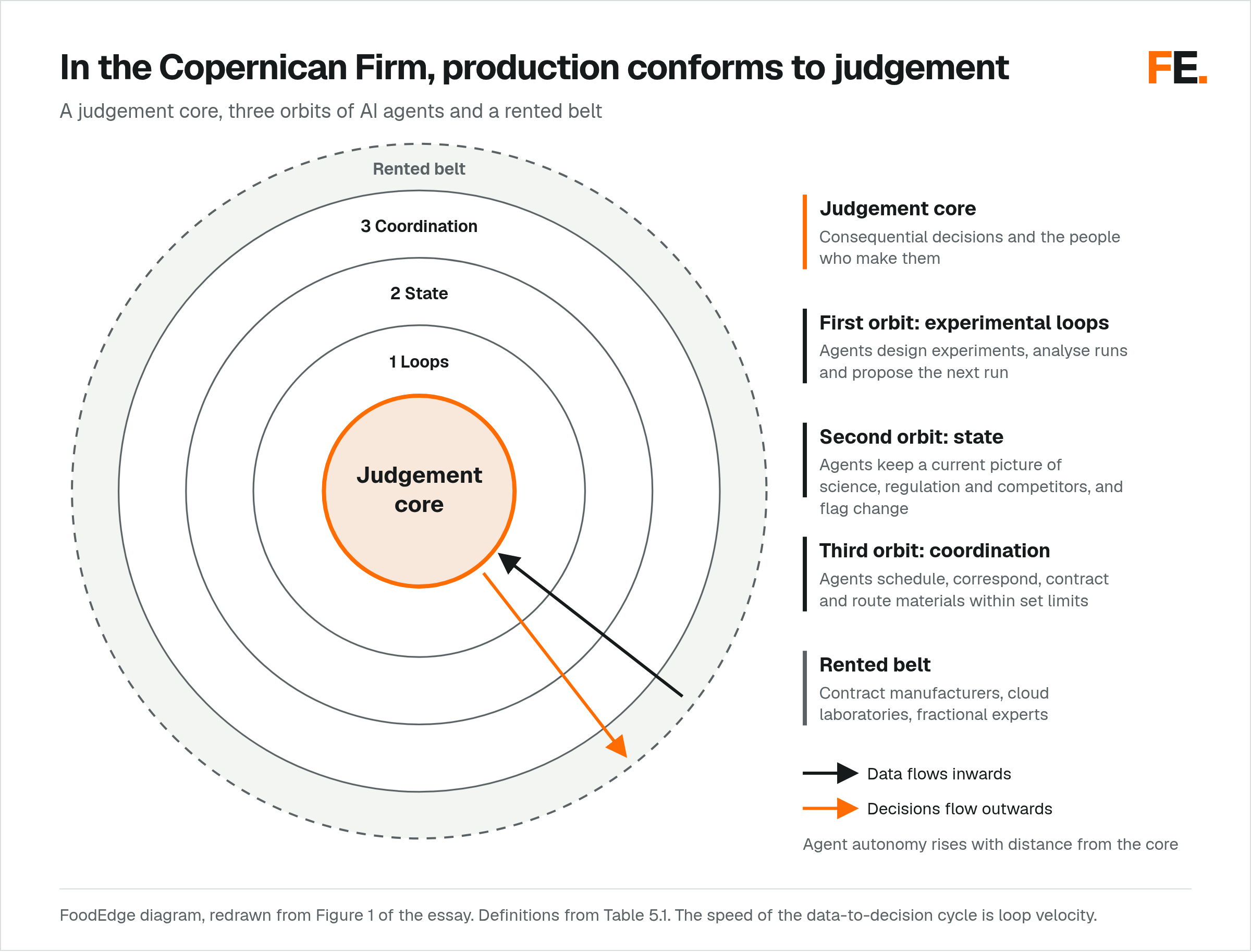
The architecture has a direction. Data flows inwards: a run ends in a rented tank, the coordination orbit receives the results, the state orbit sets them against what is already known, and the experimental orbit turns them into ranked proposals for the core. Decisions flow outwards along the same path, ending in a booked run in the belt. The speed of this cycle is loop velocity.
5.3 Two ideal types
Copernican Firm: work arranged around the judgement core in three orbits of AI agents, with physical capacity and specialist expertise rented at the edge. Production conforms to judgement.
| Ptolemaic Firm | Copernican Firm | |
|---|---|---|
| Protected centre | Technical core: owned plant and processes | Judgement core: consequential decisions and the people who make them |
| How capacity is chosen | Capacity push: what can we make to fill our plant? | Judgement pull: what must we learn next, and where should we rent the capacity to learn it? |
| Role of AI agents | Productivity tools inside functions | Orbits arranged by distance from the core |
| Ownership of production data | The plant owner, by default | The core, by contract |
| Characteristic failure | Sunk capacity dictating strategy | A hollow core or a leaky belt |
The names borrow from the history of astronomy, but the meaning comes from philosophy. In the preface to the second edition of the Critique of Pure Reason (1787), Immanuel Kant described his own inversion as Copernican: instead of knowledge conforming to objects, objects conform to the way they are known. In the Ptolemaic Firm, judgement conforms to production, because the plant one owns sets the limits of strategy. In the Copernican Firm, production conforms to judgement. Unlike some recent uses of the metaphor in writing on AI, which move people away from the centre, this one moves the factory away and keeps human judgement in the middle.
5.4 Five mechanisms
- Boundary mechanism. When the cost of coordination falls faster than the specificity of assets rises, the efficient boundary of the venture contracts towards its judgement core.
- Inverse autonomy. The closer a layer of agents sits to the core, the more consequential its errors, so the fewer final decision rights it should hold. Autonomy can rise everywhere over time; the claim concerns its relative distribution.
- Bench-to-tank discount (moderator). As experiments approach industrial scale, the cost per data point rises and the gain per iteration falls, weakening the effect of agent capability on progress.
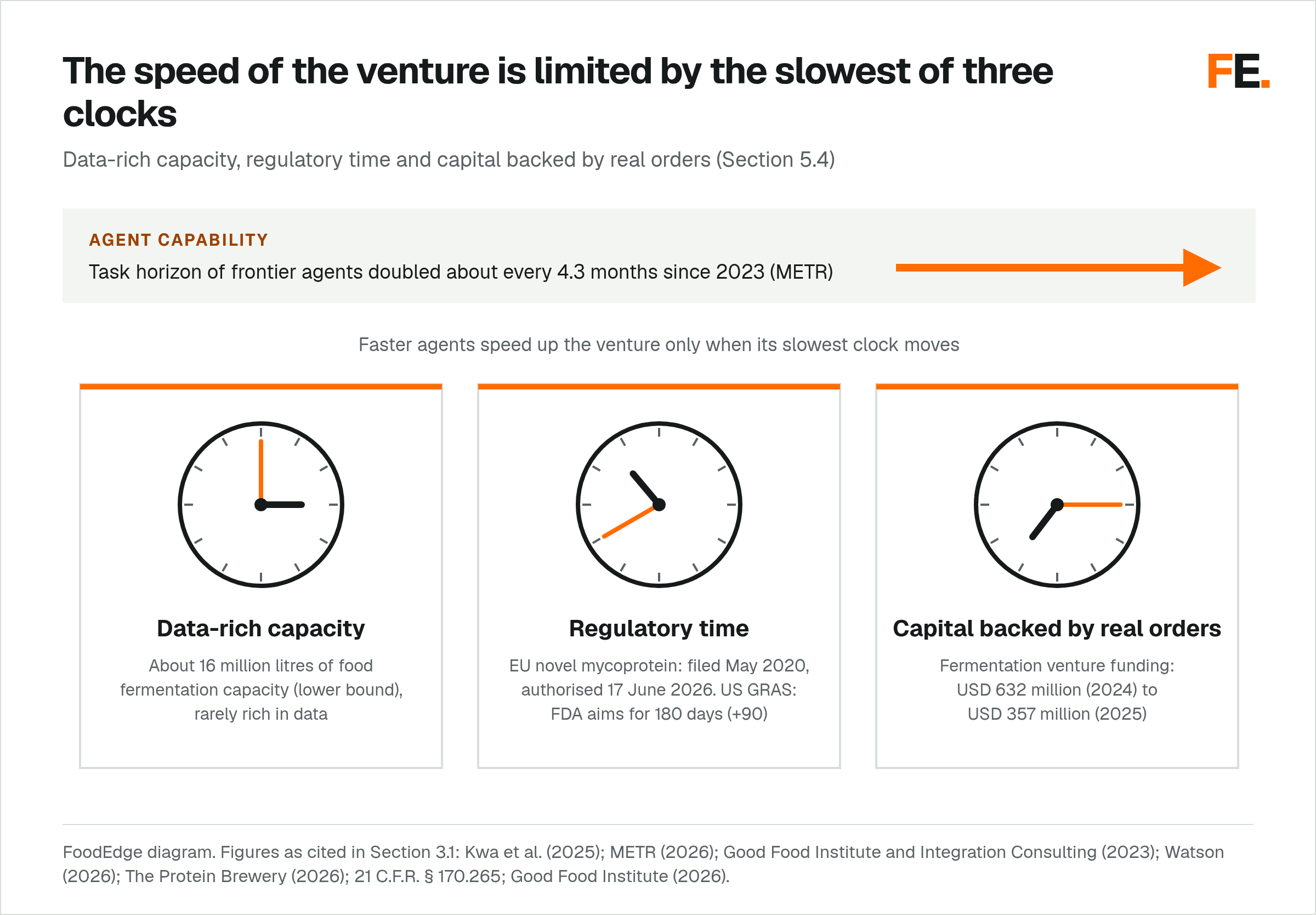
- Triad constraint. The speed of the venture is limited by the slowest of three clocks: data-rich capacity, regulatory time and capital backed by real orders.
- Memory clause. When production is rented, value accrues to whoever holds rights to the data production generates.
5.5 Failure modes
| Failure mode | What happens | Mechanism violated |
|---|---|---|
| Hollow core | The founders cannot evaluate the science, so they cannot check the agents | Competence condition of the judgement core |
| Ptolemaic relapse | Capacity is bought before demand is confirmed, and the plant begins to dictate strategy | Boundary mechanism |
| Leaky belt | Capacity is rented without rights to its data, and the contract manufacturer accumulates the learning | Memory clause |
| Stale orbit | The picture of science and regulation stops updating, and decisions rest on an old map | State orbit function |
| Runaway orbit | Agents near the core are allowed to commit rather than propose | Inverse autonomy |
6. Six propositions, each with its premises, its mechanism and the result that would refute it
Each proposition below is written as a chain: the premises it rests on (with the evidence grade from Section 3), the mechanism that links premises to prediction, the prediction itself, and the observation that would count against it. The propositions apply within the boundary conditions set out in Section 8.
P1. The judgement ratio rises with agent capability
As the capability of AI agents increases, the members of a science-based venture's judgement core spend a growing share of their time evaluating options and committing to decisions, and a shrinking share producing the material on which decisions are based.
- Premises: agent capability on long tasks is rising quickly (strong); AI assistance compresses the gap between novice and expert performance (strong, outside food).
- Mechanism: the cost of producing analyses, drafts and options falls faster than the cost of deciding among them, so the scarce activity shifts to deciding.
- Prediction: in repeated time-use measurements, the judgement ratio of founders in agent-intensive ventures increases year on year, faster than in comparable ventures with low agent use.
- Would be refuted by: no increase, or an increase in time spent producing material, despite rising agent use.
P2. Loop velocity predicts progress, up to the slowest clock
Among science-based ventures at comparable stages, loop velocity predicts the time to technical milestones better than headcount or capital raised; this relationship weakens as experiments approach industrial scale and is capped by the slowest of three clocks: data-rich capacity, regulatory time and capital backed by real orders.
- Premises: closed experimental loops produce large gains at bench scale (strong) and much smaller gains at production scale (moderate); capacity, regulation and capital each constrain speed (moderate to strong).
- Mechanism: progress in physical science is a function of verified learning per unit of time; headcount and capital affect progress mainly through the number of verified runs they buy. The bench-to-tank discount moderates the effect, and the triad constraint bounds it.
- Prediction: loop velocity explains more variance in milestone timing than headcount or capital; the explanatory power falls at pilot and production scale; ventures blocked by regulation or offtake show no benefit from higher loop velocity until the block is removed.
- Would be refuted by: headcount or capital explaining milestone timing as well as or better than loop velocity.
P3. Early ownership of capacity raises the risk of failure
Science-based ventures that commit to owned production capacity before demand is confirmed by binding orders fail more often than comparable ventures that rent.
- Premises: fermentation funding nearly halved in a year (strong); several well-funded ventures with heavy capacity commitments failed (moderate, not a random sample); renting preserves real options (established theory).
- Mechanism: owned capacity converts flexible capital into a sunk, specific asset before uncertainty about demand is resolved, and pushes strategy towards filling the plant (capacity push) rather than learning what to make.
- Prediction: in a coded sample of ventures, failure rates are higher where owned capacity preceded confirmed offtake, after controlling for capital raised and technology type.
- Would be refuted by: equal or lower failure rates among early owners.
P4. Memory share drives iteration speed and value retention
Among ventures that rent production, those holding full rights to the data their rented runs generate iterate faster and retain a larger share of the value they create.
- Premises: owners of complementary assets capture value from innovation (established theory); the leading pure-play foundry captured most of its market (strong, by analogy); contract manufacturers seek margins above food-industry norms (moderate).
- Mechanism: data from runs is the input to the venture's experimental orbit; without rights to it, learning accumulates with the manufacturer, and the venture's switching costs rise.
- Prediction: ventures with higher memory share show higher loop velocity, lower switching costs between manufacturers and higher valuations at later rounds, relative to comparable ventures.
- Would be refuted by: no difference, or an advantage for ventures without data rights.
P5. Small hybrid founding teams outperform, and the gap widens with agent use
Small founding teams (a solo founder, two or sometimes three founders) that between them combine the competences the venture needs, including the ability to evaluate the core science, outperform teams that pair a scientist with purely commercial founders, and the difference grows as the venture's use of agents increases.
- Premises: absorptive capacity depends on knowledge held inside the firm (established theory); small founding teams are common: in 2025, 36% of start-ups closing rounds on Carta had two founders, and solo founders led about 36% of new start-ups (Walker and Dowd, 2026) (strong).
- Mechanism: as agents produce more options, the binding skill becomes verification of their output; a commercial founder who cannot judge the science cannot verify, so judgement concentrates in one person and the core becomes fragile.
- Prediction: after controlling for capital and technology, small hybrid teams reach milestones faster and fail less often, with the gap increasing in the intensity of agent use.
- Would be refuted by: no gap, or a gap that narrows as agent use grows.
P6. Autonomy near the core raises the cost of errors
The closer to the judgement core that AI agents are given authority to commit rather than propose, the higher the frequency and cost of serious errors.
- Premises: errors differ in consequence by type of decision (established theory); high automation and human control can coexist (established theory).
- Mechanism: decisions near the core are irreversible or regulated; an error committed there escapes before human judgement can intercept it, while errors in coordination are cheap to reverse.
- Prediction: in incident reviews, costly errors cluster where agents held authority to commit in experimental or regulatory work, rather than in coordination.
- Would be refuted by: costly errors distributed evenly across orbits regardless of the authority granted.
6.1 How the propositions relate
P1, P5 and P6 describe properties of the judgement core itself. P2 and P4 describe the Copernican configuration around it. P3 describes the process of moving towards that configuration, and the cost of reversing it. A single venture that showed a high judgement ratio, hybrid founders, high memory share and rented capacity, yet progressed no faster than its Ptolemaic peers, would be a serious problem for the theory as a whole.
7. Implications: own the decisions and the data, rent the steel, delegate the coordination
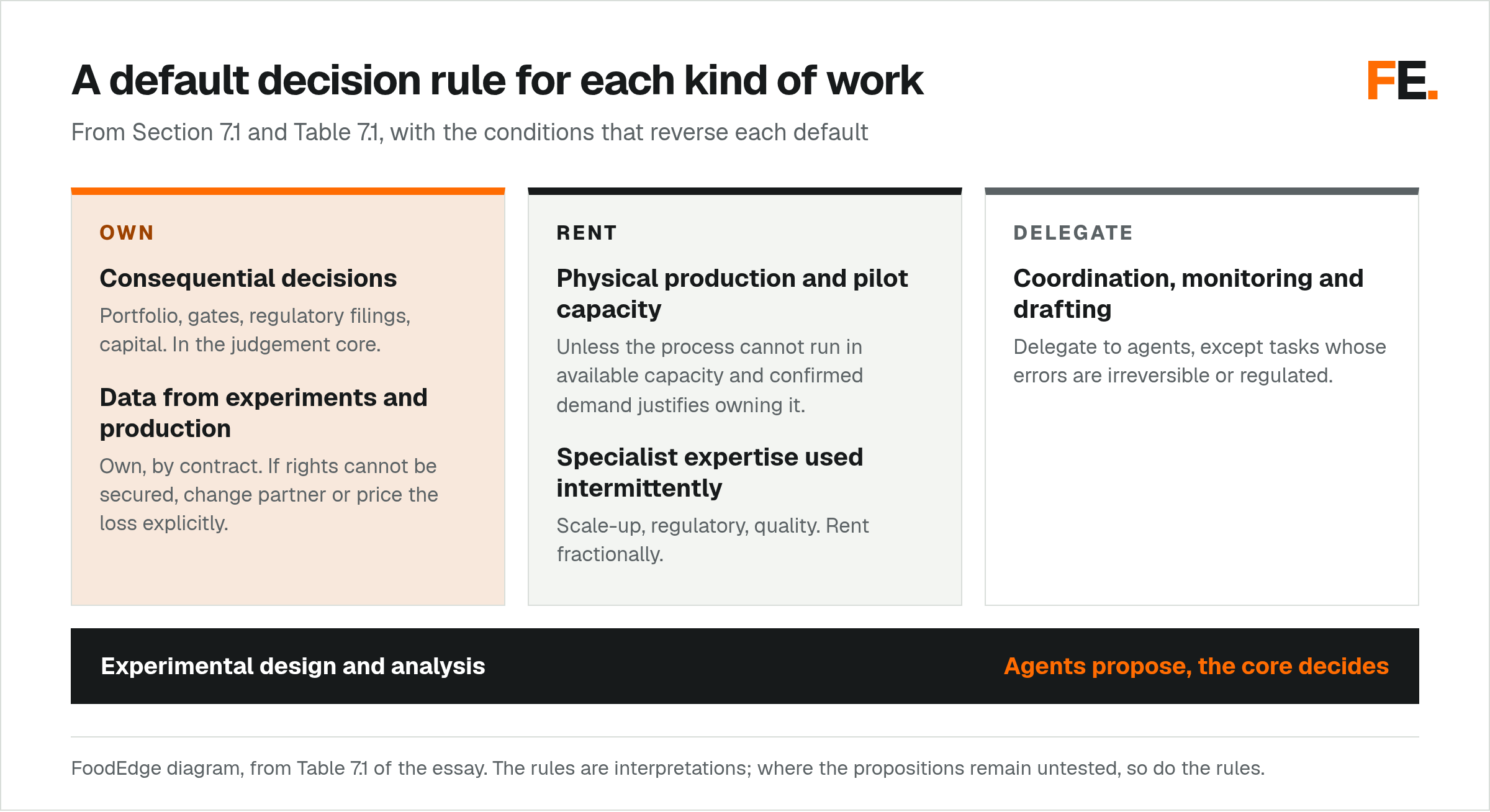
A theory of organisation earns practical value when it changes decisions. This section translates the propositions into decision rules for five groups. The rules are interpretations; where the propositions remain untested, so do the rules.
7.1 A decision rule: own, rent or delegate
| Activity | Default | Conditions that reverse the default |
|---|---|---|
| Consequential decisions: portfolio, gates, regulatory filings, capital | Own, in the judgement core | None; delegating these is the definition of a hollow core |
| Data generated by experiments and production | Own, by contract | None; if rights cannot be secured, change partner or price the loss explicitly |
| Physical production and pilot capacity | Rent | A process so specific that it cannot run in available capacity, and confirmed demand that justifies owning it |
| Specialist expertise used intermittently (scale-up, regulatory, quality) | Rent, fractionally | Expertise needed continuously, or tacit knowledge that becomes the venture's core advantage |
| Coordination, monitoring and drafting | Delegate to agents | Tasks whose errors are irreversible or regulated |
| Experimental design and analysis | Agents propose, the core decides | None in the current state of the technology |
7.2 For founders
The most important hire is often a co-founder, and the most important qualification is the ability to judge the core science, whatever that person's commercial role (P5). Before signing any manufacturing contract, read the data clause first and the price second (P4). Sequence regulatory routes so that faster approvals generate revenue and data while slower ones proceed in parallel; in the United States, the FDA aims to answer a GRAS notification within 180 days (21 C.F.R. § 170.265), while the first EU authorisation of a novel mycoprotein took six years (Watson, 2026). And measure from the first month the five numbers below, because a company that cannot see its own loop velocity cannot manage it.
Before signing any manufacturing contract, read the data clause first and the price second.
7.3 For investors
Due diligence can be shortened to four questions.
2. How fast does the company learn, from one physical run to the next improved run?
3. Who owns the data from the capacity it rents?
4. Which of the three clocks binds it now?
The theory also implies that capital for science-based ventures will increasingly split in two: venture capital to fund learning, and infrastructure or project finance, backed by binding orders, to fund steel. Funds that mix the two in one instrument may be encouraging the Ptolemaic relapse they later write off.
7.4 For corporate innovation managers
Large food and pharmaceutical companies are, almost by construction, Ptolemaic: their plants sit at the centre of their accounts and their careers. The theory leaves their existing organisation in place and suggests building new ventures as Copernican units from the start, in the spirit of the structural ambidexterity described by O'Reilly and Tushman (2004): separate units with their own judgement core, renting capacity from the parent company's own plants under a contract that gives the unit rights to its data. The parent then becomes a supplier with a strong interest in the unit's learning, which is a healthier relationship than ownership of an experiment it does not understand.
7.5 For contract manufacturers
For manufacturers, the theory points to a choice of business model. One option is to sell litres and keep the data, which captures value in the short term and invites customers to leave as soon as they can. The other is to sell instrumented capacity with data rights attached, and to build trust on the principle that made TSMC the leading foundry: never compete with a customer. The second option is slower to monetise and harder to copy.
7.6 For policymakers
If regulatory time is one of the three clocks, regulatory design becomes innovation policy. Structured scientific dialogue before submission, regulatory sandboxes that include novel foods, and shared, instrumented pilot facilities would each shorten a clock that no amount of private investment in AI can shorten.
7.7 A dashboard of five indicators
Loop velocity: the inverse of the time from the end of one physical run to the start of the next run designed with its results.
Memory share: the share of data generated in rented facilities that the venture holds with unrestricted rights of use.
Gate latency: the time between the evidence for a decision becoming available and the decision being taken.
Belt ratio: the share of physical capacity spend that is contracted rather than owned.
| Indicator | What it measures | Healthy direction | Warning sign |
|---|---|---|---|
| Judgement ratio | Share of the core's time spent deciding | Rising over time | Founders spending most of their time producing material agents could produce |
| Loop velocity | Speed from one physical run to the next improved run | Rising, within the limits of the three clocks | Long gaps between runs with no external cause |
| Memory share | Share of run data owned outright | At or near full ownership | Any contract without explicit data rights |
| Gate latency | Time from evidence to decision | Short and stable | Proposals queuing at the core, a sign the core needs help to judge |
| Belt ratio | Share of capacity spend that is rented | High until demand is confirmed | A sudden fall before binding orders, the first symptom of a Ptolemaic relapse |
8. Limitations, boundary conditions and a research agenda: what would have to be done to turn a plausible theory into a tested one
8.1 Boundary conditions
The theory is proposed for ventures that meet five conditions: their product must be grown, made or tested in the physical world; their market is regulated; experimentation is expensive and slow; they are at an early stage, before demand is confirmed by binding orders; and a market exists in which capacity and expertise can be rented. Food biotech meets all five. Industrial biotechnology, advanced materials and parts of pharmaceutical development meet most of them.
The theory should not be expected to hold for pure software companies, where the belt is thin and the clocks are fast; for established companies as a whole, where it applies first to new units; or in jurisdictions where data rights in contracts cannot be enforced, since the Memory Clause then has nothing to rest on.
8.2 Limitations
Five limitations should be stated plainly. First, the study is conceptual: its propositions are derived, not tested. Second, part of the evidence is analogical; the semiconductor case shows a mechanism that fermentation may or may not repeat. Third, the evidence for the bench-to-tank discount rests on a small number of studies with different methods. Fourth, visible failures in fermentation are not a random sample of ventures, so they illustrate P3 without testing it. Fifth, the author's roles in FoodEdge, at MycoVibes Biotech and as an evaluator create interests in how the phenomenon is described, which is why independent analysis is part of the agenda below.
A sixth limitation concerns the speed of the field. Between February and June 2026 alone, several working papers proposed new accounts of AI and the boundaries of the firm, including the headless firm (Klein and Wieczorek, 2026), the minimum viable firm (Li and Shi, 2026) and accountability boundaries (Hydari and Muzaffar, 2026). The claims of novelty made here (the epistemic layering of agents, the judgement core in physical and regulated science, and the Memory Clause) will need to be checked again against the literature before formal publication.
8.3 Research agenda
| Proposition | Suggested design | Data | First step |
|---|---|---|---|
| P1 judgement ratio | Repeated time-use study | Calendars and diaries of founders, with consent | A pilot with five to ten ventures |
| P2 loop velocity | Panel study of milestone timing | Run logs, milestone dates, headcount and funding | Agree a common definition of a run and a milestone |
| P3 early ownership | Event-history analysis of failure | Coded funding rounds and post-mortems | Code the 172 rounds and 47 post-mortems in the FoodEdge record for owned versus rented capacity at each stage |
| P4 memory share | Contract analysis linked to outcomes | Manufacturing contracts, anonymised; later funding rounds | Partnership with one contract manufacturer and one law firm |
| P5 small hybrid teams | Matched comparison of founding teams | Team size, founder backgrounds, agent use, outcomes | Add team composition to the FoodEdge coding |
| P6 autonomy near the core | Incident review across ventures | Records of costly errors and the authority granted to agents | A shared, anonymous incident template |
The first step for P3 can begin immediately, because the data already exist. It should be carried out with an academic partner who has no stake in FoodEdge or in any venture studied, and the coding rules should be published before the results.
9. Conclusion: the protected centre has moved, and the question now is who holds it
The essay set out to answer three questions. Its answers, offered for testing, are these.
RQ1. What should a science-based venture keep inside its boundary? Its judgement core, the consequential decisions and the competent, accountable people who make them, together with the rights to the data its experiments produce. Most of the rest, including production, can and usually should be rented until demand is confirmed.
RQ2. How should AI agents be arranged? In orbits distinguished by the kind of knowing they do, experimentation, keeping state and coordination, with authority to act rising with distance from the core and falling as decisions become irreversible.
RQ3. When does renting create value rather than leak it? When the venture holds rights to the data from rented runs, when the capacity it rents is instrumented to return that data, and when its partners are bound by a relationship of trust that makes competing with their customers unattractive. Without these, renting transfers the venture's learning to the owner of the steel.
For half a century, organisation theory told companies to protect the factory at their heart. For a growing class of science-based ventures, that advice no longer describes where the risk lies. The factory can now be rented; judgement still has to be owned. The Copernican Firm is a name for what follows when a company accepts that change and arranges itself around it. Whether the theory survives contact with data is the next question, and the most useful thing an essay of this kind can do is make that question easy to ask.
The factory can now be rented; judgement still has to be owned.
How to cite this article
Adamek, A. M. (2026, October 27). The Judgement Core: How AI Agents and Rented Capacity Are Redrawing the Science-Based Venture. FoodEdge. https://foodedge.eu/judgement-core/
References
Theory and method
- Agrawal, A. K., Gans, J. S., & Goldfarb, A. (2018). Prediction, judgment and complexity: A theory of decision making and artificial intelligence (NBER Working Paper No. 24243). National Bureau of Economic Research. https://doi.org/10.3386/w24243
- Amdahl, G. M. (1967). Validity of the single processor approach to achieving large scale computing capabilities. In Proceedings of the April 18–20, 1967, Spring Joint Computer Conference (pp. 483–485). Association for Computing Machinery. https://doi.org/10.1145/1465482.1465560
- Chesbrough, H. W. (2003). Open innovation: The new imperative for creating and profiting from technology. Harvard Business School Press. https://openlibrary.org/search?q=Open+innovation+Chesbrough
- Christensen, C. M., & Raynor, M. E. (2003). The innovator's solution: Creating and sustaining successful growth. Harvard Business School Press. https://openlibrary.org/search?q=The+innovator%27s+solution+Christensen
- Coase, R. H. (1937). The nature of the firm. Economica, 4(16), 386–405. https://doi.org/10.1111/j.1468-0335.1937.tb00002.x
- Cohen, W. M., & Levinthal, D. A. (1990). Absorptive capacity: A new perspective on learning and innovation. Administrative Science Quarterly, 35(1), 128–152. https://doi.org/10.2307/2393553
- Cooper, R. G. (1990). Stage-gate systems: A new tool for managing new products. Business Horizons, 33(3), 44–54. https://doi.org/10.1016/0007-6813(90)90040-I
- Goldratt, E. M., & Cox, J. (1984). The goal: Excellence in manufacturing. North River Press. https://openlibrary.org/search?q=The+goal+Goldratt+Cox
- Handy, C. (1989). The age of unreason. Business Books. https://openlibrary.org/search?q=The+age+of+unreason+Handy
- Jaakkola, E. (2020). Designing conceptual articles: Four approaches. AMS Review, 10(1–2), 18–26. https://doi.org/10.1007/s13162-020-00161-0
- Kant, I. (1787). Kritik der reinen Vernunft (2nd ed.). Johann Friedrich Hartknoch. https://www.deutschestextarchiv.de/book/show/kant_rvernunft_1787
- Malone, T. W., Yates, J., & Benjamin, R. I. (1987). Electronic markets and electronic hierarchies. Communications of the ACM, 30(6), 484–497. https://doi.org/10.1145/214762.214766
- McGrath, R. G. (1999). Falling forward: Real options reasoning and entrepreneurial failure. Academy of Management Review, 24(1), 13–30. https://doi.org/10.2307/259034
- Mintzberg, H. (1979). The structuring of organizations: A synthesis of the research. Prentice-Hall. https://openlibrary.org/search?q=The+structuring+of+organizations+Mintzberg
- O'Reilly, C. A., III, & Tushman, M. L. (2004). The ambidextrous organization. Harvard Business Review, 82(4), 74–81. https://hbr.org/2004/04/the-ambidextrous-organization
- Parasuraman, R., Sheridan, T. B., & Wickens, C. D. (2000). A model for types and levels of human interaction with automation. IEEE Transactions on Systems, Man, and Cybernetics – Part A: Systems and Humans, 30(3), 286–297. https://doi.org/10.1109/3468.844354
- Pisano, G. P. (2006). Science business: The promise, the reality, and the future of biotech. Harvard Business School Press. https://openlibrary.org/search?q=Science+business+Pisano
- Popper, K. R. (1959). The logic of scientific discovery. Hutchinson. https://openlibrary.org/search?q=The+logic+of+scientific+discovery+Popper
- Ries, E. (2011). The lean startup: How today's entrepreneurs use continuous innovation to create radically successful businesses. Crown Business. https://openlibrary.org/search?q=The+lean+startup+Ries
- Sætre, A. S., & Van de Ven, A. H. (2021). Generating theory by abduction. Academy of Management Review, 46(4), 684–701. https://doi.org/10.5465/amr.2019.0233
- Sarasvathy, S. D. (2001). Causation and effectuation: Toward a theoretical shift from economic inevitability to entrepreneurial contingency. Academy of Management Review, 26(2), 243–263. https://doi.org/10.2307/259121
- Shneiderman, B. (2020). Human-centered artificial intelligence: Three fresh ideas. AIS Transactions on Human-Computer Interaction, 12(3), 109–124. https://doi.org/10.17705/1thci.00131
- Sturgeon, T. J. (2002). Modular production networks: A new American model of industrial organization. Industrial and Corporate Change, 11(3), 451–496. https://doi.org/10.1093/icc/11.3.451
- Teece, D. J. (1986). Profiting from technological innovation: Implications for integration, collaboration, licensing and public policy. Research Policy, 15(6), 285–305. https://doi.org/10.1016/0048-7333(86)90027-2
- Teece, D. J., Pisano, G., & Shuen, A. (1997). Dynamic capabilities and strategic management. Strategic Management Journal, 18(7), 509–533. https://doi.org/10.1002/(SICI)1097-0266(199708)18:7<509::AID-SMJ882>3.0.CO;2-Z
- Thompson, J. D. (1967). Organizations in action: Social science bases of administrative theory. McGraw-Hill. https://openlibrary.org/search?q=Organizations+in+action+Thompson
- Weick, K. E. (1989). Theory construction as disciplined imagination. Academy of Management Review, 14(4), 516–531. https://doi.org/10.2307/258556
- Williamson, O. E. (1985). The economic institutions of capitalism: Firms, markets, relational contracting. Free Press. https://openlibrary.org/search?q=The+economic+institutions+of+capitalism
AI, organisation and the boundaries of the firm
- Brynjolfsson, E., Li, D., & Raymond, L. R. (2025). Generative AI at work. Quarterly Journal of Economics, 140(2), 889–942. https://doi.org/10.1093/qje/qjae044
- Hydari, M. Z., & Muzaffar, F. (2026). Redrawing the AI map: A theory of accountability boundaries in agentic ecosystems (arXiv:2605.23179). arXiv. https://doi.org/10.48550/arXiv.2605.23179
- Kim, H., & Koning, R. (2026). AI-native firms (Harvard Business School Working Paper No. 26-090). Harvard Business School. https://www.hbs.edu/ris/Publication%20Files/26-090_96f92aa0-37d9-4789-beaa-5c0cb87a4032.pdf
- Klein, T., & Wieczorek, S. (2026). The headless firm: How AI reshapes enterprise boundaries (arXiv:2602.21401). arXiv. https://doi.org/10.48550/arXiv.2602.21401
- Kwa, T., West, B., Becker, J., Deng, A., Garcia, K., Hasin, M., Jawhar, S., Kinniment, M., Rush, N., Von Arx, S., Bloom, R., Broadley, T., Du, H., Goodrich, B., Jurkovic, N., Miles, L. H., Nix, S., Lin, T., Painter, C., … Chan, L. (2025). Measuring AI ability to complete long software tasks (arXiv:2503.14499). arXiv. https://doi.org/10.48550/arXiv.2503.14499
- Li, W., & Shi, A. (2026). Minimum viable firm: Rethinking venture creation in the age of AI-native entrepreneurship [Preprint]. SSRN. https://doi.org/10.2139/ssrn.7387996
- METR. (2026, January 29). Time horizon 1.1. https://metr.org/blog/2026-01-29-time-horizon-1-1/
- Shahidi, P., Rusak, G., Manning, B. S., Fradkin, A., & Horton, J. J. (2025). The Coasean singularity? Demand, supply, and market design with AI agents (NBER Working Paper No. 34468). National Bureau of Economic Research. https://doi.org/10.3386/w34468
- Spataro, J. (2025, April 23). The 2025 Annual Work Trend Index: The Frontier Firm is born. Official Microsoft Blog. https://blogs.microsoft.com/blog/2025/04/23/the-2025-annual-work-trend-index-the-frontier-firm-is-born/
- Sukharevsky, A., Krivkovich, A., Gast, A., Storozhev, A., Maor, D., Mahadevan, D., Hämäläinen, L., & Durth, S. (2025, September 26). The agentic organization: Contours of the next paradigm for the AI era. McKinsey & Company. https://www.mckinsey.com/capabilities/people-and-organizational-performance/our-insights/the-agentic-organization-contours-of-the-next-paradigm-for-the-ai-era
Science, capacity, capital and regulation
- 360iResearch. (2026). Precision fermentation market: Global forecast 2026–2032 [Market research report]. Research and Markets. https://www.researchandmarkets.com/report/precision-fermentation
- Aminetzah, D., Levene, J., Brennan, T., & Toews, K. (2025, March 13). Ingredients for the future: Bringing the biotech revolution to food. McKinsey & Company. https://www.mckinsey.com/industries/agriculture/our-insights/ingredients-for-the-future-bringing-the-biotech-revolution-to-food
- Carta. (2025). State of seed 2025. https://carta.com/data/resources/state-of-seed-2025/
- EFSA NDA Panel [EFSA Panel on Nutrition, Novel Foods and Food Allergens]. (2025). Safety of Rhizomucor pusillus biomass powder as a novel food pursuant to Regulation (EU) 2015/2283. EFSA Journal, 23(12), Article e9707. https://doi.org/10.2903/j.efsa.2025.9707
- Focus Taiwan. (2026, March 13). TSMC rides AI wave to net nearly 70% of global foundry market in 2025. Central News Agency. https://focustaiwan.tw/business/202603130009
- Good Food Institute & Integration Consulting. (2023). Manufacturing capacity landscape and scaling strategies for fermentation-derived protein. https://gfi.org/wp-content/uploads/2023/01/Fermentation-manufacturing-capacity-analysis.pdf
- Good Food Institute. (2026). 2026 state of the industry report: Fermentation for meat, seafood, eggs, dairy, and ingredients. https://gfi.org/wp-content/uploads/2026/04/GFI-2026-State-of-the-Industry-report-Fermentation-for-meat-seafood-eggs-dairy-and-ingredients.pdf
- GRAS notices: FDA response, 21 C.F.R. § 170.265 (2026). https://www.ecfr.gov/current/title-21/chapter-I/subchapter-B/part-170/subpart-E/section-170.265
- High, L. (2025, May 15). Meati closing in on deal to sell meat-alternative biz for paltry $4M. BizWest. https://bizwest.com/2025/05/15/meati-closing-in-on-deal-to-sell-meat-alternative-biz-for-paltry-4m/
- Hung, L., Yager, J. A., Monteverde, D., Baiocchi, D., Kwon, H.-K., Sun, S., & Suram, S. (2024). Autonomous laboratories for accelerated materials discovery: A community survey and practical insights. Digital Discovery, 3(7), 1273–1279. https://doi.org/10.1039/D4DD00059E
- Magrini, E. (2026, August 20). The rise of fractional leadership. Lightcast. https://lightcast.io/resources/blog/rise-of-fractional-leadership
- Maximize Market Research. (2026, March 13). Precision fermentation market size: Industry analysis and forecast (2026–2032) [Market research report]. https://www.maximizemarketresearch.com/market-report/precision-fermentation-market/195708/
- Singh, N., Lane, S., Yu, T., Lu, J., Ramos, A., Cui, H., & Zhao, H. (2025). A generalized platform for artificial intelligence-powered autonomous enzyme engineering. Nature Communications, 16, Article 5648. https://doi.org/10.1038/s41467-025-61209-y
- The Protein Brewery. (2026, June 17). Fermotein authorised in the EU [Press release]. https://www.theproteinbrewery.com/fermotein-authorized-eu
- Vidra, E. (2025, December 12). The state of seed and pre-seed in 2025: Bigger bets, leaner teams, and the AI distortion field. VC Cafe. https://www.vccafe.com/the-state-of-seed-and-pre-seed-in-2025-bigger-bets-leaner-teams-and-the-ai-distortion-field/
- Walker, P., & Dowd, K. (2026, March 12). Founder ownership report 2026. Carta. https://carta.com/data/founder-ownership-2026/
- Walker, P., & Shad, H. (2025, December 9). Solo founders report 2025. Carta. https://carta.com/data/solo-founders-report/
- Walsh, I., Shozui, F., Sato, A., Park, U., Cho, H., & Chia, C. (2025). Toward machine learning-guided CHO bioprocess and media optimization for improved titer and glycosylation. Biotechnology Journal, 20(11), Article e70149. https://doi.org/10.1002/biot.70149
- Watson, E. (2024, September 7). Foodtech startup Motif FoodWorks is closing down. AgFunderNews. https://agfundernews.com/exclusive-boston-based-foodtech-startup-motif-foodworks-is-closing-down
- Watson, E. (2026, June 17). The Protein Brewery wins EU approval for Fermotein mycoprotein six years after novel foods filing. AgFunderNews. https://agfundernews.com/the-protein-brewery-wins-eu-approval-for-fermotein-mycoprotein-six-years-after-novel-foods-filing
- Zhang, H. G., Eckmann, P., Miao, J., Mahon, A. B., & Zou, J. (2026). The Virtual Biotech: A multi-agent AI framework for therapeutic discovery and development. Science, 394(6822), Article eaeg6779. https://doi.org/10.1126/science.aeg6779
- Zournas, A., Incha, M. R., Radivojevic, T., Blay, V., Martí, J. M., Costello, Z., Schmidt, M., Chung, T., Thompson, M. G., Pearson, A., Kinnunen, P. C., Eng, T., Lawson, C. E., Tan, S., Ogorzalek, T., Kaplan, N., Forrer, M., Backman, T., Mukhopadhyay, A., … Garcia Martin, H. (2025). Machine learning-led semi-automated medium optimization reveals salt as key for flaviolin production in Pseudomonas putida. Communications Biology, 8, Article 630. https://doi.org/10.1038/s42003-025-08039-2
All references checked against their DOI or source page on 29 October 2026.
Companion essays: Judgement Is Not for Rent; From Technical Core to Judgement Core: The Copernican Firm.