

Opinion by Dr. Adam M. Adamek. First published on Substack on 21 April 2026. Revised for republication on 16 October 2026. The opening scene and worked example are wholly hypothetical. The frameworks are editorial models, not measured conversion data.
Imagine two rooms on the morning a pilot is announced. This is a wholly hypothetical scene, not a reported meeting or an experience attributed to the author.
In the startup’s room, the team is celebrating. A message lands in the group chat. Someone drafts a LinkedIn post. Investors hear that a recognised food company has agreed to test the ingredient. After months of development, there is finally an external yes.
In the buyer’s room, the picture is incomplete. The innovation sponsor has approved an experiment, but the team has not yet agreed who would authorise a larger order. The relevant supplier requirements, production conditions and budget for the next step remain to be clarified. The pilot is real. Its route to repeat revenue is still an open question.
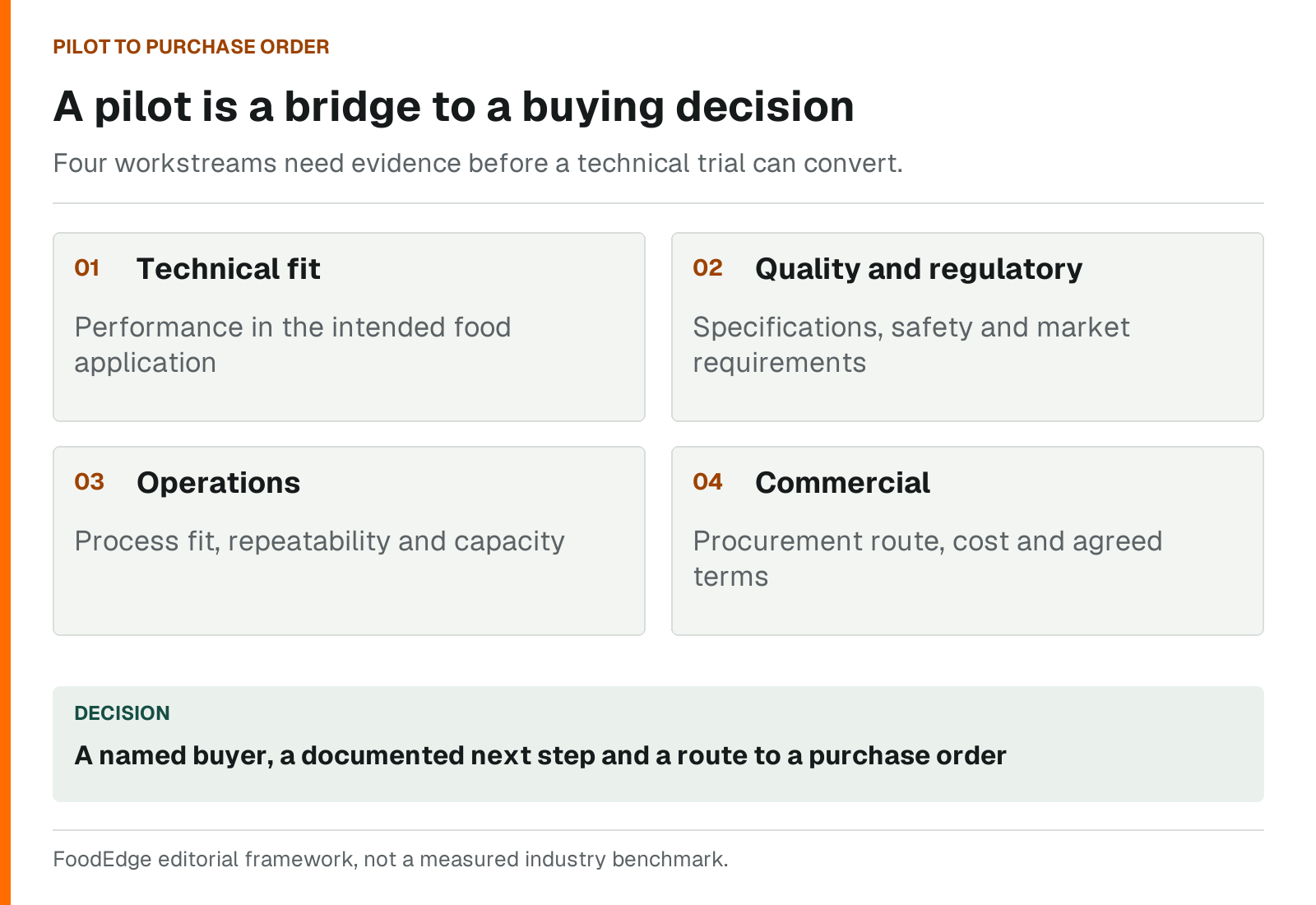
Those two rooms are a useful metaphor for corporate pilot purgatory: the distance between permission to learn and permission to buy at the scale the startup’s plan assumes. That distance can be short, long or irrelevant to a deliberately exploratory trial. The mistake is describing it as already crossed when the evidence says otherwise.
The assumption to challenge
A pilot signature can be meaningful commercial evidence. It may bring paid work, technical learning, access to a customer or a binding development commitment. It does not automatically establish repeat demand, a commercial-scale order or an approved supplier relationship covering every intended use.
The announcement is easy to understand. The buying process is harder to see. A familiar logo can travel from a press release to a board presentation while the conditions for the next purchase remain unstated. This is a risk in interpreting evidence, not a measured claim about how all founders, investors or innovation teams behave.
Use precise descriptions. A paid trial is a paid trial. A development agreement is a development agreement. A purchase order commits what its terms actually commit. Each can be valuable without being presented as another kind of evidence. The useful question is what decision the pilot enables, who owns it and what remains before that person can say yes.
One-minute brief
Founders: map the route from this trial to the next buying decision. Identify the people, evidence and approvals relevant to this buyer. A polished announcement should not substitute for that map.
Innovators: keep developing the ingredient, while checking what the buyer needs beyond the technical result. Better performance may matter, but it will not answer every question about supply, specification or purchasing authority.
Investors: ask what the pilot has demonstrated and what it contractually commits. Separate completed tests, paid development, conditional interest and repeat orders. Ask for the next decision and the evidence needed to reach it.
Five functions to investigate
Procurement, quality and regulatory, operations, finance and legal provide a practical starting map. This is an editorial heuristic, not a requirement that every buyer has five separate departments or five mandatory stakeholders. Responsibilities may overlap, be delegated or sit with the innovation sponsor. Some functions will be less relevant to a particular trial.
Start by asking the buyer how decisions work for this product and purchase. Map responsibilities before counting meetings. If one person has several authorities, record that. If an approval is unnecessary, record why. The aim is to understand the actual route rather than make the organisation conform to a diagram.
1. Procurement: what enables an order?
“Procurement will be involved in the next phase” is a question to unpack. Which phase, what triggers involvement, and who can explain the steps? The sentence does not prove that a file has never been opened. It does leave a dependency that the founder should understand before forecasting a larger order.
Ask about supplier onboarding, category ownership, purchasing terms and the route for this particular transaction. A vendor identifier may be part of that route. It is not a universal test of whether a pilot or contract is real. Buyers can have different arrangements for research purchases, commercial supply, services and existing suppliers.
Unilever describes its supplier qualification system as supporting approval, due diligence, risk assessment and audit verification where needed. It says new suppliers that cannot meet its responsible-sourcing terms cannot be onboarded and receive purchase orders. That is evidence of Unilever’s stated process, not a universal sequence for every food buyer.
Useful records might include onboarding status, agreed supplier terms, an assigned category contact or a request for quotation. Their meaning depends on the transaction. Two documents from a generic list do not establish readiness. Ask the buyer which requirements remain, who owns them and whether anything can proceed in parallel with the technical work.
Put the answer into the forecast: “supplier review requested, owner confirmed, information due on this date” is more useful than “procurement engaged”. It gives the team a next action and lets a reviewer distinguish a planned introduction from work already completed.
2. Quality and regulatory: accepted for which use?
An enthusiastic sensory review is evidence about the assessment that took place. It may be important to the buying decision. It should not be presented as approval of food safety, manufacturing controls, regulatory status or every intended application unless those matters were actually reviewed by the people responsible.
Ask what the customer needs for the ingredient, its production site and intended use. Possible topics include hazard analysis, allergen controls, traceability, specifications, analytical methods and a certificate of analysis. An audit may be required, with its scope determined by the buyer’s process. This is a set of questions to resolve, not a claim that every supplier needs the same dossier or an on-site audit.
Nestlé’s supplier guidance describes compliance assessment tools that vary with supply-chain tier and risk, including the goods supplied and their origin. Its responsible-sourcing requirements form part of purchase orders and supply contracts. This supports checking the actual customer requirements instead of assuming one fixed qualification workflow.
Keep regulatory status separate from customer acceptance. Where an ingredient and intended use fall within EU novel food requirements, the relevant authorisation and its conditions matter before placing it on the market. The European Commission explains the authorisation procedure and Union-list conditions. “Food biotech” alone does not establish that a product needs a new novel food application. Check the actual ingredient, use and applicable entry rather than assuming a fixed approval timetable.
In the US, the FDA distinguishes food additive approval from GRAS uses. GRAS means generally recognised as safe under the intended conditions of use. GRAS notification is voluntary under the framework described by the FDA; it is not a mandatory filing for every new biotech ingredient. A company remains responsible for lawful, safe use, and the applicable route needs to be established for the product.
Record what has actually been accepted: a specification version, a manufacturing site, a batch, a proposed use or a regulatory assessment. Identify open questions and the person qualified to resolve them. A forwarded slide deck can start that review. It cannot establish its conclusion.
3. Operations: what changes on the line?
A successful trial in an application kitchen answers a different question from production under the buyer’s operating conditions. It may provide a strong reason to proceed. It does not, on its own, establish throughput, handling requirements or repeatability on the equipment intended for commercial use.
Ask what needs testing at the next relevant scale. Depending on the product, that could include ingredient feeding, storage, mixing, heating, cleaning, changeover, yield or operator instructions. Establish which observations from the earlier trial transfer and which require further evidence. Do not dismiss useful laboratory work simply because it was done outside a commercial plant.
Agree the trial’s decision criteria before reserving equipment. What constitutes an acceptable result? Who can accept a deviation? Which conditions must be repeated, and what batch information must accompany the ingredient? Those questions make it easier to distinguish a learning exercise from a qualification decision.
Useful evidence could include an agreed protocol, a production contact, a scheduled slot, trial records and a documented decision about the outcome. A calendar invitation is not a completed test. A completed test is not necessarily approval for every line or product. Keep the scope visible when reporting progress.
Plant time also creates an economic question. Ask what capacity, staff time and materials the trial requires, and who funds them. A delayed slot could reflect maintenance, safety, capacity or commercial priority. It does not prove that the sponsor lacks influence. Record the explanation, agree a realistic next step and assess whether the startup can support the revised timetable.
4. Finance: who funds the next step?
“The pilot has an innovation budget; commercial conversion will have its own budget” can describe a legitimate arrangement. The missing information is how the next budget is decided. An innovation team may have purchasing authority and a substantial budget. Another may fund experiments while a business unit controls larger orders. Check rather than infer.
Separate the commitment already made from the funding being proposed. What does the present budget cover: samples, paid development, a production run or ongoing supply? Who can authorise additional spending, and within which limits? Is the next allocation approved, conditional or still a request? Those distinctions are more useful than demanding a budget code as a test of credibility.
The buyer may need to assess price, cost in use, expected volume, working capital or equipment spending. Ask which commercial assumptions matter to that assessment. A lower ingredient price may not compensate for additional handling or downtime. Conversely, a higher price may be acceptable if the ingredient provides valuable functionality at a lower inclusion level. Test the actual business case.
Useful evidence might include a named budget holder, an agreed commercial model, authorised spending or a documented approval decision. A budget holder’s email can clarify a next step without committing a year of volume. A long-term agreement may still contain conditions. Read what each record establishes rather than treating the presence of four artefacts as a universal finance gate.
Bring this back to the startup’s cash plan. A promising opportunity can require more time and cash than the team can afford. Put the expected payments, production commitments and collection dates alongside the buyer’s next decision. That makes it possible to discuss rescoping or timing before the startup commits further resources.
5. Legal: what have the parties committed?
An NDA, a co-development agreement and a supply agreement can serve different purposes. Their titles do not settle their legal effect. A co-development agreement may contain binding payment, delivery, intellectual-property, exclusivity or purchasing obligations. An NDA may also create enforceable obligations. Neither should be dismissed as a promise to keep talking.
Review the actual terms with appropriately qualified counsel. What must each side deliver? Who owns the resulting data, improvements and intellectual property? Can the startup supply other customers? What happens if a trial is delayed, specifications change or either party ends the project? Distinguish binding commitments from forecasts, intentions and conditions that remain unsatisfied.
For a supply arrangement, examine the relevant product specification, ordering mechanism, payment terms, responsibilities for defects, insurance, continuity and termination. These are topics to investigate, not clauses that every transaction must contain in the same form. The appropriate allocation depends on the product, jurisdiction and negotiated agreement.
Use the payment terms actually agreed. There is no sector-wide number in this framework. Model deposits, invoice triggers, acceptance conditions and the possibility of a disputed or late payment. A headline contract value is less useful to a cash forecast if the company has not understood when it can invoice and collect.
The practical record is a short explanation of what is committed now, what remains conditional and who can resolve the open terms. Keep the underlying documents available. An internal summary helps the team act, but it does not replace the agreement or determine its legal interpretation.
The 5x5 organisation map
The original framework pairs five functions with five engagement states. Use it as a conversation aid, adapted to the buyer’s organisation. It is not a validated score, a probability of conversion or an instruction to obtain twenty-five approvals. One current state per relevant responsibility is enough, with evidence and the next action alongside it.
- Not contacted: no relevant contact has been established. The team still needs to confirm whether that responsibility applies and who owns it.
- Aware: the responsible person has received enough information to recognise the project. Receipt is not acceptance.
- Engaged: the owner has taken an identifiable action and agreed a next step. Record what happened rather than relying on the label alone.
- Approved: the authorised person has approved a defined scope. State the conditions, date and decision being approved.
- Integrated: the agreed requirement is incorporated into the relevant operating or purchasing process. Define that process and avoid implying that future orders are guaranteed.
Add “not applicable”, “unknown” or a different state where needed. Do not turn missing information into a negative finding. A supplier might already be qualified, a legal review might be unnecessary for the current purchase, or several decisions might sit with one person. Explain those circumstances in the record.
Do not average the labels or automatically assign the whole pilot its lowest state. Instead, identify dependencies that could block the specific next decision. An unresolved safety requirement can matter more than an unsigned optional document. Prioritise the dependency according to its relevance, timing and consequence.
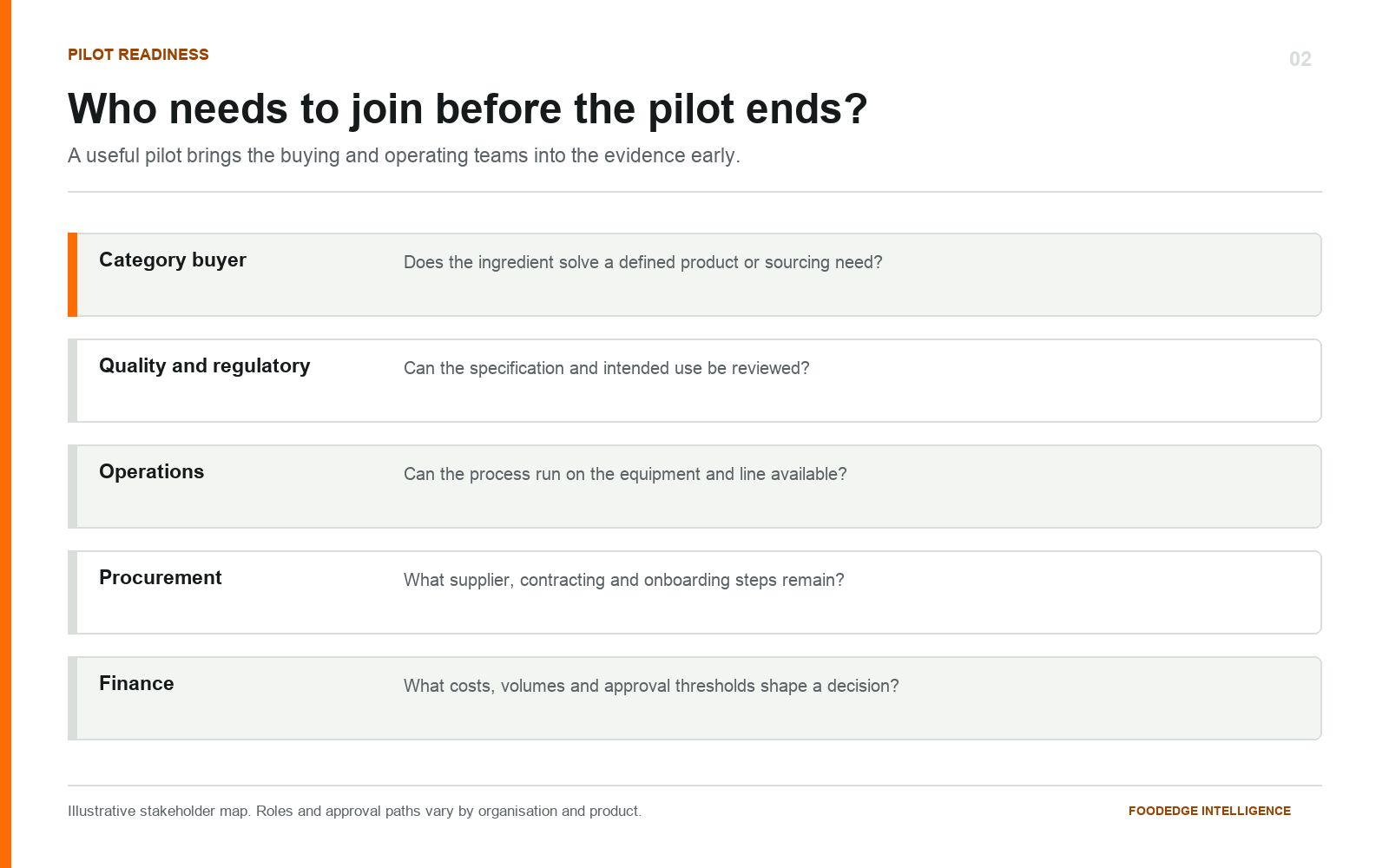
The diagram groups practical questions by stakeholder. The text above groups responsibilities by function. Both are editorial models; map legal authority and other responsibilities wherever they sit in the actual organisation. Neither model establishes a mandatory headcount or approval sequence.
A wholly hypothetical worked example
Imagine a precision-fermentation dairy-ingredient startup working with a large food manufacturer. This is a wholly hypothetical scenario, not a composite of documented companies, a client case or a claimed commercial outcome. The invented facts below exist only to demonstrate how to use the map.
The innovation sponsor has agreed a development trial. The startup has permission to publicise the collaboration, but its sales forecast assumes repeat ingredient orders that are not committed. The map records these invented states:
- Procurement, unknown: the sponsor has not yet confirmed which supplier route applies to later orders.
- Quality and regulatory, aware: the proposed specification has been received; the scope of review remains to be agreed.
- Operations, not contacted: the team has not established who would decide whether a production trial is needed.
- Finance, unknown: the present trial budget is agreed, while authority for a larger purchase has not been confirmed.
- Legal, engaged: development terms have been discussed; counsel needs to clarify what is binding and what remains conditional.
The read-out is specific: a development trial exists, while evidence supporting the forecast of repeat orders is incomplete. Calling it imaginary would ignore the actual agreement. Calling it a converted commercial customer would overstate what the invented evidence establishes.
The next action is a working conversation with the sponsor about the decision after the trial. Ask which responsibilities apply, who can answer the open questions and what information they need. Agree dates that match the buyer’s process and the startup’s cash constraints. If the answer is a deliberate exploratory project with no purchasing plan, report it that way and decide whether the learning still justifies the work.
For founders: manage the hand-off
Before an announcement, describe the commitment precisely and confirm any permissions to use the buyer’s name. A second stakeholder can improve continuity, but their presence is not a universal threshold for announcing a genuine agreement. The point is that the public description should match the signed scope and the work under way.
Set a review cadence you can act on. For example, choose fourteen days to check whether an agreed introduction has happened, then seven days to decide whether to escalate or revise the plan. Those are self-imposed management intervals, not evidence-based conversion thresholds. A missed interval does not establish that a pilot is false or doomed.
Keep the map in the customer record. After each material conversation, update the evidence, owner, open dependency and next date. Use the same distinctions in board updates. “Trial completed; buying decision pending” is clear progress. It also prevents technical success from quietly becoming booked future revenue in the narrative.
For innovators: translate the evidence
Technical fluency is an asset. Use it to explain the evidence that each decision needs. A production contact may ask about handling; quality may ask about variability; a purchaser may need lead times and order quantities. The same underlying process can require different explanations without changing the facts.
Work with the innovation sponsor to identify those questions. Do not assume the sponsor lacks authority or cannot buy. Ask what they can commit, what they can introduce and what support they need from the startup. Respect the sponsor’s knowledge of the organisation while checking the route on which the commercial forecast depends.
Keep scientific and commercial uncertainties visible together. A missing procurement contact can be a problem, and so can an unresolved technical result. Better introductions will not repair an ingredient that misses the agreed specification. Better titre will not settle an unagreed contract. The useful plan gives each question an owner and evidence requirement.
For investors: diligence the commitment
Ask what the pilot demonstrates, what the buyer has committed and which decision follows. Then ask for the evidence supporting that account. A supplier intake form can be relevant, but it is one possible record rather than a universal gate or a test of founder quality.
Review the signed scope, paid work, test results, customer correspondence and assumptions behind future volumes. Respect confidentiality when requesting customer access. Separate a founder’s estimate from the buyer’s stated intention and from an enforceable obligation. Those distinctions make it easier to assess the commercial evidence without treating every exploratory project as a failure.
Three questions before you celebrate
- What has the buyer actually agreed to fund, test, buy or decide, and where is that recorded?
- If the current champion left tomorrow, who else would understand the project and the next decision?
- Which unresolved requirement could prevent that decision, and what is the agreed next action?
Return to the two rooms. There can be good work happening in both, at different speeds and for different purposes. Your job is to make the connection explicit: the result the pilot must produce, the person authorised to act on it and the conditions for the next commitment. That is the work behind a credible route from trial to revenue.
Primary-source checks: Unilever supplier guidance, Nestlé supplier guidance, FDA food additive and GRAS guidance, and European Commission novel food authorisation guidance were read on 16 October 2026. Their scope is described at the relevant claims above. The practical recommendations and examples are analysis, not a survey.
Explore related FoodEdge reports, or contact the editor with a question about your next commercial decision.


