A list went viral on X this week.
"Status symbols." Greg Isenberg posted it on 12 November. When I checked: 582,447 views, 7,207 bookmarks [1].
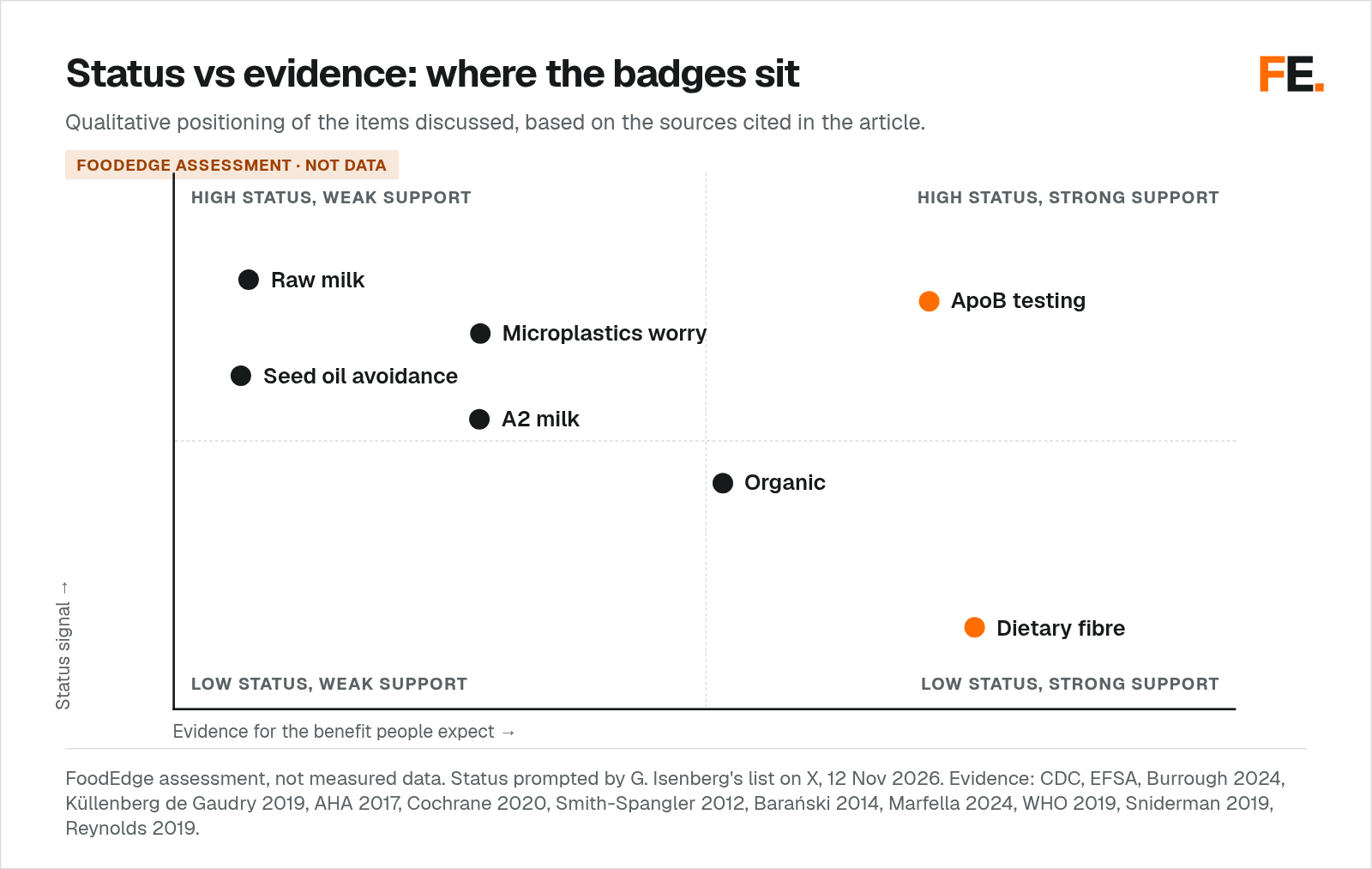
Scroll it. Old Porsche. Limewash walls. And then my whole field, dressed up for the party. Your ApoB. Your water. Microplastics. Raw A2 milk from a farm drop. Seed oils, discussed "a lot". Organic. Bone broth.
First read, I laughed.
Second read, I stopped.
On that list your food is a flag you wave. What it does inside you barely gets a line.
And the money saw it before you did.
The badge sells for more than the outcome. Capital pours into "clean". Capital pours into "ancestral". It's pricing the signal, and somebody has to check the biology.
Fine. I'll check the biology.
ApoB earns its place
Credit where it's due. ApoB is the one I'd defend with my mouth full.
Every atherogenic lipoprotein particle carries one apoB molecule. One. A 2019 review in JAMA Cardiology argued that apoB measures that risk more accurately than LDL or non-HDL cholesterol [2].
You want a biomarker for a badge? Take this one. Wear it.
Raw milk comes with a bird flu caveat
Raw milk can carry Campylobacter, E. coli, Listeria, Salmonella. The list keeps going.
Good farm hygiene cuts contamination. US health officials say it still can't guarantee you're safe [3].
EU member states: 27 outbreaks linked to raw milk, 2007 to 2013 [4].
Twenty-seven.
Then 2024. H5N1 got into US dairy cattle. Cats fed raw milk and colostrum from infected cows developed fatal infections [5].
Fatal. And you put it on a status list.
I'll leave that there. Unrefrigerated.
A2 milk: a real claim, and a small one
A 2019 systematic review: moderate certainty that A1 beta-casein causes more digestive trouble than A2 [6].
Everything else? Low certainty. Or very low.
So maybe a calmer gut, for some people. Real claim, small claim. You can't build a personality on a stomach, though plenty are out there trying.
Seed oils: loud online, beaten in the trials
Most airtime. Least support.
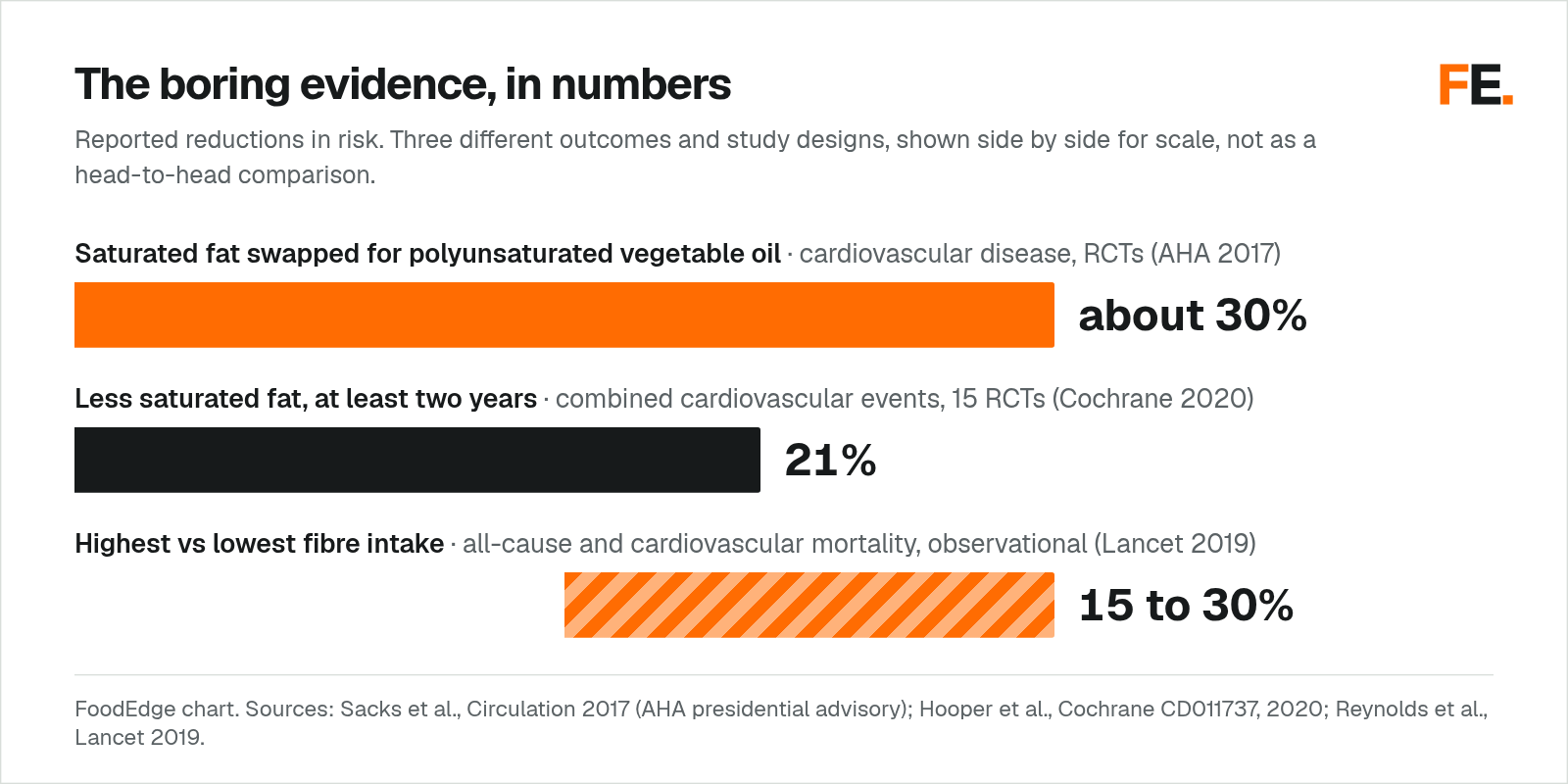
Swap saturated fat for polyunsaturated vegetable oil and the trials show about 30% less cardiovascular disease. Roughly a statin's worth. That's the American Heart Association's 2017 reading [7].
Then Cochrane, 2020. Fifteen randomised trials. Cut saturated fat and combined cardiovascular events fell 21%, with polyunsaturated fat among the swaps that worked [8].
Thirty.
Twenty-one.
Rant at the deep fryer all you want, mate. The butter dish still loses.
Organic: honestly split
Here I have to play it straight. The data won't let me swing.
Stanford, 2012: no strong evidence that organic food is significantly more nutritious. It did find lower pesticide residues, and a lower risk of antibiotic resistant bacteria in organic chicken and pork [9].
British Journal of Nutrition, 2014: higher antioxidant concentrations, less cadmium, fewer pesticide residues in organic crops [10].
So the food is different.
Are the people eating it healthier? Still open. And you're paying a premium for an open question.
Microplastics: the worry is real, the science is unfinished
I won't laugh at this one.
A 2024 NEJM study found micro and nanoplastics in the carotid plaque of 58.4% of patients. Those patients had a higher risk of heart attack, stroke or death over about 34 months [11].
Scary number. One observational cohort of surgical patients, though. Association, yes. Proof the plastic did it, no.
WHO, back in 2019: on the limited information available, microplastics in drinking water did not appear to pose a health risk at current levels. More research needed [12].
So worry. Worry is free.
The fancy water costs extra, and so far it's a bet in a nice bottle.
The winner nobody posts
The Lancet, 2019. A series of meta-analyses: 185 prospective studies, 58 clinical trials.
In the observational data, people eating the most fibre had 15 to 30% lower all-cause and cardiovascular mortality than people eating the least. Less coronary heart disease, stroke, type 2 diabetes and colorectal cancer as well. Biggest risk reductions at 25 to 29 g a day [13].
Read that again. Then go and find the lentils on that list.
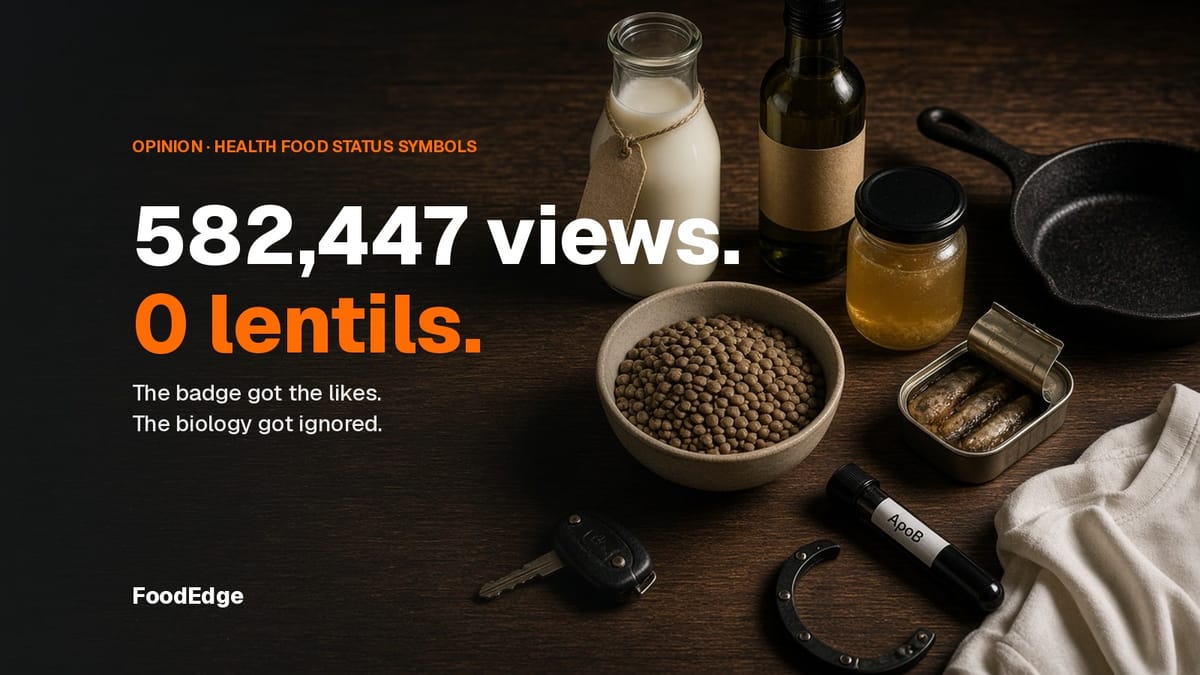
582,447 views.
Zero lentils.
Nobody posts a lentil. Beans don't trend. Fibre does its work in the dark, with nobody clapping.
Terrible brand. Brilliant intervention.
Where the money goes
Premium? I've got no beef with premium.
Signal sells. Someone who wears your product as an identity haggles less than someone who just wants dinner, and investors love what that does to gross margin.
Then GLP-1 kicked the door in. Arguably the status drug of the decade. Appetite control on prescription, in a pen.
Think about what that does to you, the "clean" brand. The outcome now comes in a pen. The food that used to promise the outcome needs a new job, and for a lot of you the only job left is the badge.
Earlier this month FoodEdge ran the GLP-1 arithmetic for a snack brand: a 10% fall in snack spending among user households came out at about 1% of revenue.
One per cent. Survivable.
Status is nastier. It never shows up in the spreadsheet. It shows up the day it walks out.
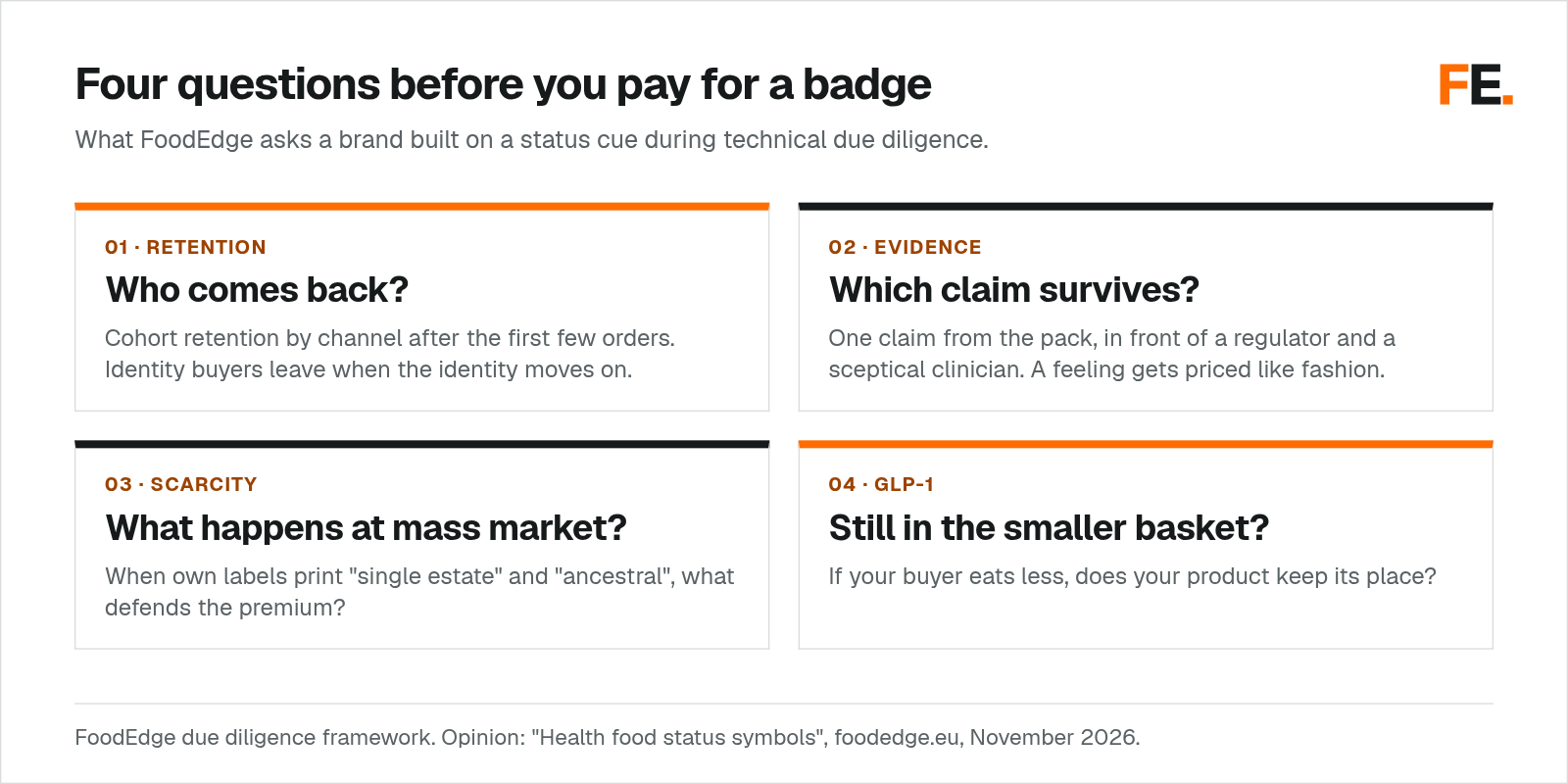
Four questions before you pay for a badge
Built on a status cue? Then in diligence you get these.
- Who comes back? Show me cohort retention by channel after the first few orders. Identity buyers leave when the identity moves on.
- Which claim survives? Take one claim off your pack. Put it in front of a regulator and a sceptical clinician. If your honest answer is "the brand is a feeling", you get priced like fashion.
- What happens at mass market? Status needs scarcity. The day supermarket own labels print "single estate" and "ancestral", something else has to defend your premium. Name it. Now.
- What does a GLP-1 customer need from you? Smaller basket. Are you still in it?
Question two makes founders sweat. Good. Sweat early. We published a short exercise for matching each pitch claim to the evidence it can carry, and protein packs have already shown how a claim can grow when the serving size grows with it.
The European bit
One line on that list made me laugh out loud: taking all of August off "like an old-world European".
Olive oil. Tinned fish. Broth, and a long Sunday table with the phones away. Much of what gets sold back as luxury used to be ordinary European eating.
European founder pitching into the US or Asia? That's your opening. It's also your trap.
Heritage sells as a story. As proof it's worth about as much as the farm photo.
The white label test
You're about to back a health food brand. One test.
Strip the logo. Strip the farm photos and the founder's podcast tour.
Plain white pack, next to the cheap, boring option. Measure what happens to the body.
Does the outcome still justify the price?
If yes, you've got a moat made of biology. If not, what you've actually bought is a fashion label with a nutrition panel, and fashion runs on seasons.
Proof before hype.
Sources checked on 14 November 2026
- Greg Isenberg, "Status symbols today", X, 12 November 2026 (views and bookmarks read 14 November 2026). https://x.com/gregisenberg/status/2120955557465223337
- Sniderman AD et al. Apolipoprotein B particles and cardiovascular disease: a narrative review. JAMA Cardiology 2019;4(12):1287-1295. https://pubmed.ncbi.nlm.nih.gov/31642874/
- CDC. Raw milk. Updated 31 January 2025. https://www.cdc.gov/food-safety/foods/raw-milk.html
- EFSA. Raw drinking milk: what are the risks? 13 January 2015. https://www.efsa.europa.eu/en/press/news/150113
- Burrough ER et al. Highly pathogenic avian influenza A(H5N1) clade 2.3.4.4b virus infection in domestic dairy cattle and cats, United States, 2024. Emerging Infectious Diseases 2024;30(7):1335-1343. https://pubmed.ncbi.nlm.nih.gov/38683888/
- Küllenberg de Gaudry D et al. Milk A1 beta-casein and health-related outcomes in humans: a systematic review. Nutrition Reviews 2019;77(5):278-306. https://pubmed.ncbi.nlm.nih.gov/30722004/
- Sacks FM et al. Dietary fats and cardiovascular disease: a presidential advisory from the American Heart Association. Circulation 2017;136(3):e1-e23. https://pubmed.ncbi.nlm.nih.gov/28620111/
- Hooper L et al. Reduction in saturated fat intake for cardiovascular disease. Cochrane Database of Systematic Reviews 2020, CD011737. https://pubmed.ncbi.nlm.nih.gov/32428300/
- Smith-Spangler C et al. Are organic foods safer or healthier than conventional alternatives? A systematic review. Annals of Internal Medicine 2012;157(5):348-366. https://pubmed.ncbi.nlm.nih.gov/22944875/
- Barański M et al. Higher antioxidant and lower cadmium concentrations and lower incidence of pesticide residues in organically grown crops. British Journal of Nutrition 2014;112(5):794-811. https://pubmed.ncbi.nlm.nih.gov/24968103/
- Marfella R et al. Microplastics and nanoplastics in atheromas and cardiovascular events. New England Journal of Medicine 2024;390(10):900-910. https://pubmed.ncbi.nlm.nih.gov/38446676/
- WHO. WHO calls for more research into microplastics and a crackdown on plastic pollution. 22 August 2019. https://www.who.int/news/item/22-08-2019-who-calls-for-more-research-into-microplastics-and-a-crackdown-on-plastic-pollution
- Reynolds A et al. Carbohydrate quality and human health: a series of systematic reviews and meta-analyses. The Lancet 2019;393(10170):434-445. https://pubmed.ncbi.nlm.nih.gov/30638909/
AI tools supported source research and drafting during the editorial process.