

Motif FoodWorks had a real ingredient. That matters to any honest account of what happened to the company, and to the argument I want to make about food biotech platforms.
HEMAMI was a fermentation-derived myoglobin preparation intended to deliver meat-like flavour and aroma. FDA issued a no-questions response to Motif's GRAS conclusion in December 2021 for the specified uses, and Ginkgo's securities filing records the product's launch that year. It is wrong to describe Motif as a company that never commercialised a product or completed a regulatory route. FDA's response and Ginkgo's filing establish that much.
What those milestones do not establish is a durable, profitable ingredient business. Regulatory progress, launch, repeat orders, manufacturing economics and corporate survival are different tests. Passing the first two does not guarantee the others. Equally, a difficult corporate outcome does not prove that a company failed because it used the word platform.
That distinction makes the strategic question sharper. When does technical breadth help a young food biotech company, and when does it consume the resources needed to make one ingredient commercially dependable?
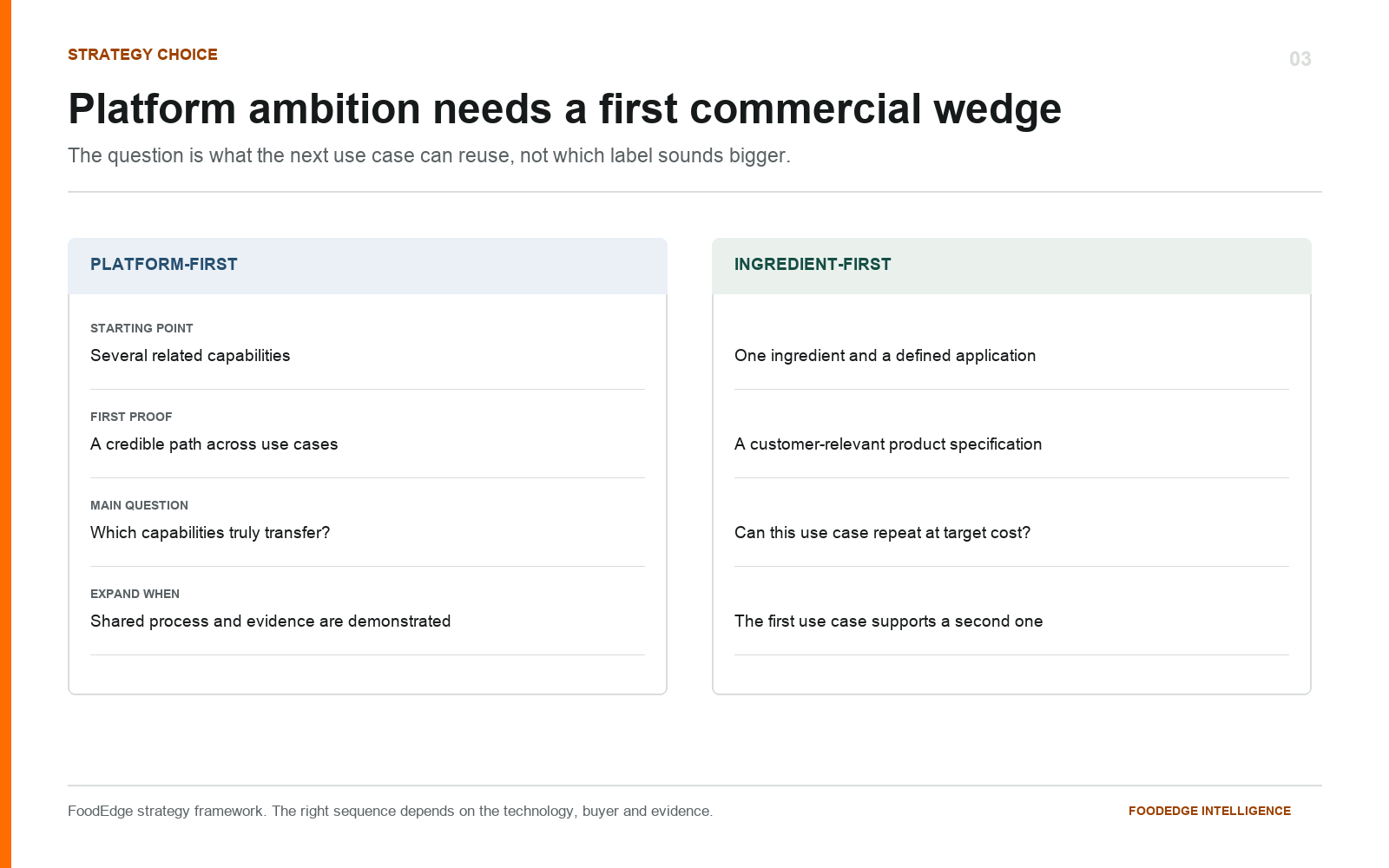
My answer is ingredient-first. Begin with a defined product, a defined application and a buyer who can say what acceptable performance means. Build the broader company from the evidence that work produces. This is an argument about sequencing under constrained capital, not a statistical claim that every focused company outperforms every diversified one.
Platforms are earned through repeatable commercial capability. Announcing one does not create it.
The myth: platform means commercial readiness
Platform is an attractive word in a fundraising conversation. It suggests a versatile technology engine, more than one addressable market and several ways to create value. Those can be genuine assets. A strain library, a screening method or a transferable manufacturing process may support multiple products over time.
The word also makes it easy to postpone a difficult choice. A founder who describes a dairy protein company commits to a category. A founder who describes a protein platform can leave the first category unresolved. Technical optionality becomes a commercial story before the company has established which option a customer will pay for.
The danger is not the vocabulary itself. It is the substitution of potential for evidence. A diagram with six applications does not show six qualified products. A partnership announcement does not show a purchase commitment. A large total addressable market does not show that the company can manufacture to a specification, deliver reliably or leave its customer with a viable margin.
In food biotech, platform can sometimes mean that the company has not yet chosen where it will earn the right to expand. That is my interpretation of a recurring strategic temptation, rather than the result of a coded survey of investor decks.
One-minute brief
Investors: ask which ingredient ships first, to which buyer and for which use. If the answer names several, ask which has priority when manufacturing time, regulatory attention or cash runs short. Breadth can be justified, but it needs a funded plan and explicit trade-offs.
Founders: ingredient-first is a way to concentrate learning. A defined specification, a manageable regulatory scope and a serious buyer qualification can make the next investment decision clearer. Focus improves the quality of the test; it does not guarantee the test will succeed.
Innovators: your expression system may produce six proteins. Your first buyer needs one product to perform in a particular formulation. Keep the scientific options alive in a proportionate way, while giving commercial development a clear first destination.
What the evidence can tell us
Industry company counts and funding reports are useful maps of activity. They are not, on their own, a dataset that links platform positioning to time to revenue, burn rate or survival. Such a comparison would need consistent definitions, launch dates, funding histories, comparable stages and a method for handling companies that have not yet reached an outcome.
I do not have that dataset. I therefore cannot claim that platform companies systematically spend longer before revenue, that the successful and unsuccessful groups do not overlap, or that the strongest investments of a particular cycle all chose one ingredient early. Those would be empirical conclusions requiring empirical work.
The narrower argument remains worth making. A small team has a finite amount of process-development time, regulatory capacity, customer access and working capital. Adding a product adds work somewhere. The practical question is how much work is genuinely shared, and how much has merely been hidden underneath the platform label.
That question is answerable inside a company. Lay out the evidence needed for each proposed product. Identify who will generate it, what it costs and which dependency can stop the programme. If three products rely on the same scientist, pilot line or application specialist, the apparent parallel plan may be a queue.
Consider an illustrative scenario, not a reported company. A fermentation start-up has one development team and enough capital to pursue one substantial scale-up campaign. Its deck lists a dairy protein, a meat flavour ingredient and a clinical nutrition application. Some analytical methods may transfer across the programmes. The customer's specification, intended use, formulation work and commercial justification may not. Keeping all three launch dates alive does not create three teams.
The point is not that breadth always multiplies cost by a fixed amount. Shared biology and manufacturing can create economies of scope. The point is to count those benefits rather than assume them, and to fund the work that remains distinct.
Three reasons to start with an ingredient
1. Operational concentration
A single first product gives the team a common object to optimise. What must it contain? How consistent must it be? What processing conditions must it tolerate? What will the customer reject? Those questions turn a general technology promise into an operational programme.
The shorthand is one specification, one qualification effort and one first commercial relationship. It is useful shorthand, but reality is less tidy. Each production lot needs appropriate release evidence; one ingredient can have several customers, grades or uses; each customer can impose different documentation and audit requirements.
A Certificate of Analysis is evidence about a batch, not a permanent certificate that the whole business is ready. A satisfactory laboratory sample is not evidence that every future lot will satisfy the buyer. Ingredient-first makes these obligations easier to see because the company has named the product around which they accumulate.
Concentration also improves the feedback loop. The application scientist hears why the ingredient failed in the customer's process. The process engineer can connect that failure to a measurable property. The commercial lead can test whether fixing it would unlock a real order. That loop is harder to manage when every meeting concerns a different application with a different definition of success.
The operational cost of breadth is therefore a planning question. Some activities run together efficiently; others compete for scarce attention. A credible platform plan should show both. If every workstream assumes first call on the same people and equipment, the plan has not yet confronted its own constraints.
2. Regulatory scope that the team can actually manage
A clear first product makes regulatory planning more concrete. The material's identity, production process, proposed uses, exposure and safety evidence determine the task. Commercial teams need that specificity before they can make sensible promises about where and when a product can be sold.
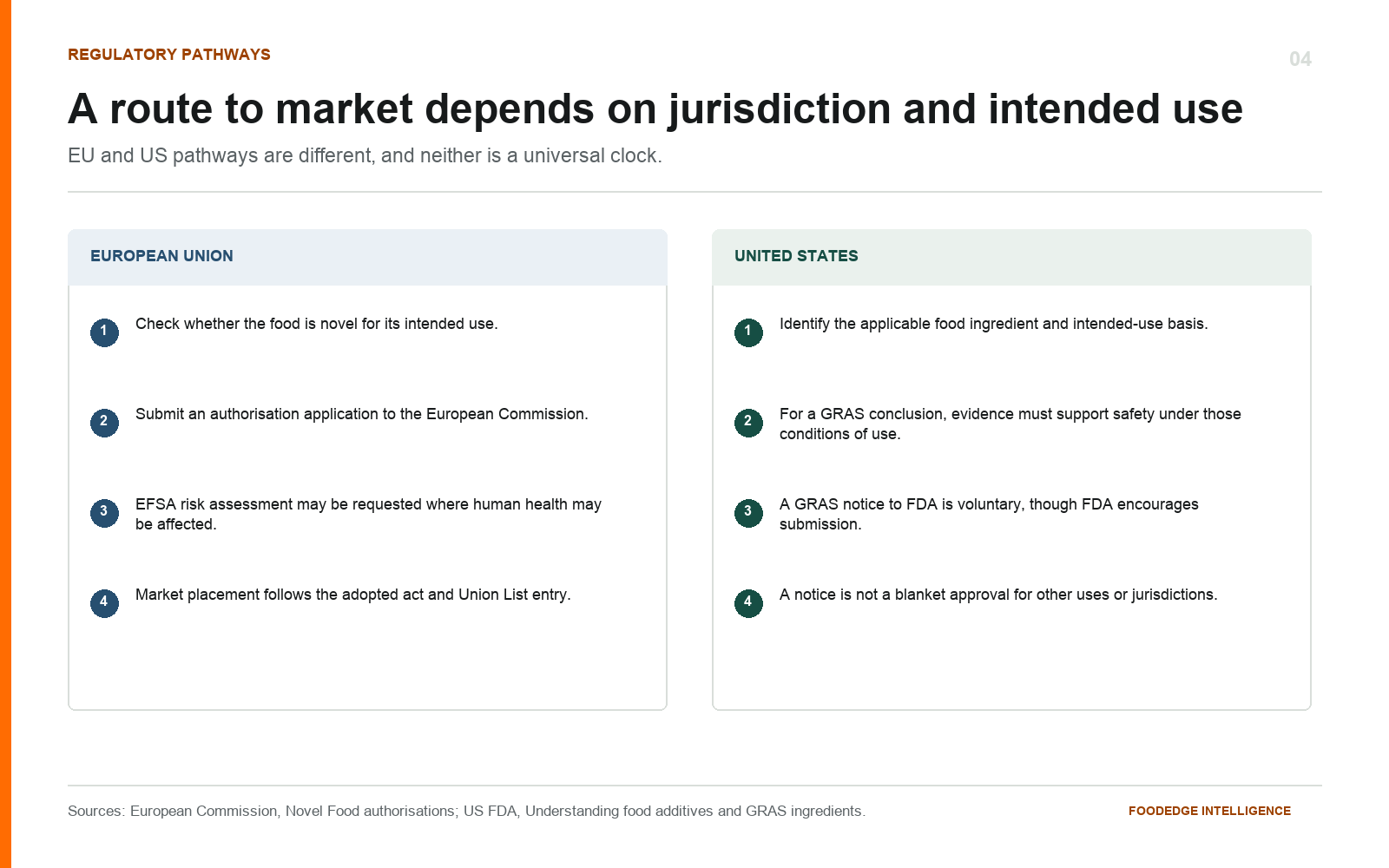
There is no universal 18-24 month route for a novel ingredient. In the EU, authorisation under the novel food framework involves an application and, where required, EFSA's safety assessment before a Commission decision. Requests for additional evidence and the completeness of the dossier affect elapsed time. The Commission's explanation is a process map, not a guaranteed launch calendar.
The US framework is different. A manufacturer may reach a GRAS conclusion without notifying FDA; a voluntary notification can receive a no-questions response. That response is distinct from food additive approval and is limited to the conditions considered. FDA's explanation of the routes also makes clear that the manufacturer remains responsible for safety and compliance.
Fewer dossiers can reduce internal coordination demands. It does not follow that regulators will assess one dossier more quickly merely because the applicant has fewer projects. Nor does one ingredient necessarily mean one regulatory route: jurisdictions, uses and changes to the product or process can require separate consideration.
The founder's task is to give each commitment a defensible scope and a budget. Parallel international work may be sensible when the data package can support it and the team can resource it. Calling sequencing a discipline should not turn sequential filing into a rule that ignores the actual regulatory strategy.
3. Buyer alignment
Procurement needs something sufficiently defined to evaluate. Quality needs a specification and appropriate assurance about production and safety. Product development needs to know what the material does in the intended recipe. Finance needs a price and a credible supply arrangement. A platform description rarely answers those questions by itself.
A founder who presents a protein, a specification, an intended use, a documented regulatory position and a price assumption has given the buyer a file to open. The next conversation can address performance and risk. A founder who presents only multi-application potential leaves the buyer to invent the first project.
Customers can, of course, enter platform partnerships. Larger businesses sometimes want discovery programmes, several ingredients or a strategic technology relationship. The distinction is whether the partner has committed resources and a decision process, or is merely interested in exploring possibilities. Curiosity is useful. It should not be booked as demand.
The first ingredient gives both sides a way to test the relationship. The buyer can specify acceptance conditions; the supplier can identify what it can deliver and at what cost. That is where commercial learning begins to replace assumptions.
Two company cases, with their limits intact
Motif: a launch is not the whole commercial test
Motif is not evidence that platform companies never produce ingredients. Its HEMAMI launch and FDA correspondence directly contradict that claim. The preparation was myoglobin made using an engineered yeast, not an enzyme-discovery product. The FDA letter also flags potential colour additive issues, a reminder that a GRAS response does not settle every possible use or regulatory question.
Ginkgo's September 2024 quarterly filing records the mutual termination of its Motif intellectual property and development agreements effective in August 2024. That is an observable contractual event. It does not provide a product-by-product account of Motif's costs, volumes or customer economics.
Without that account, I cannot credibly say that seven parallel applications exhausted the company, that every programme was underfunded, or that a different portfolio decision would have ensured survival. Those explanations would require evidence about internal decisions that the public documents do not supply.
The useful diligence question is more demanding than the original cautionary tale: after an ingredient launches, what demonstrates repeatable value? Ask for customer retention, qualified capacity, manufacturing consistency and contribution economics. A product launch is a milestone worth respecting. It is also the beginning of a further test.
Solar Foods: a defined ingredient with unfinished commercial work
Solar Foods offers a different example of concentration around a recognisable ingredient, Solein. The company uses gas fermentation to produce a protein-rich microbial biomass. That is a distinct product concept from precision fermentation of a purified target protein; the two should not be treated as identical simply because both use fermentation.
Its regulatory history also rejects a neat sequential story. Solar Foods says it submitted a Singapore dossier in September 2021 and its EU application on 29 October 2021. The Singapore submission therefore overlapped with the European route. The company announced the Singapore authorisation in October 2022, referring subsequently to approval in September 2022. See its Singapore announcement and European application update.
Solar Foods' 2025 financial release records an independent US GRAS conclusion in September 2024 and an FDA notification in September 2025. It describes Factory 01 as commercial scale, with 160 tonnes of annual design capacity achieved, and Factory 02 as a planned 6,400-tonne facility. Capacity is not the same as annual output or sales.
Its half-year report published on 11 August 2026 still listed the Factory 02 investment decision, binding offtake agreements, EU novel food approval and an FDA no-questions letter among the work ahead. Funding decisions for Factory 02 were conditional on the investment decision and total financing. That report also recorded a US consumer product launch using Solein. These are dated company disclosures, not proof that every commercial condition has since been met.
The defensible lesson is concentration around a product while several regulatory, financing and customer tasks continue. Solar Foods is not a finished success case, and its filings do not establish that only one pathway was pursued at a time. They show why technical progress, regulatory progress and commercial validation deserve separate columns.
For investors: test the first commercial commitment
Every time an investor rewards breadth without asking how it will be executed, a founder receives an incentive to add another application to the next deck. That is a risk in the funding conversation, not a claim about the motivations of every investor or founder.
The fix is to test the platform thesis. Ask the founder to name the first ingredient, the customer or customer segment, the intended application and the evidence still needed for an order. If several programmes are genuinely funded and staffed, examine their interdependencies. If they compete for the same runway, ask which one wins.
An honest answer may include uncertainty. A buyer may be under confidentiality; qualification may still be incomplete; price may depend on scale. The purpose of diligence is to expose those conditions and decide whether the investment can resolve them. It is not to demand a fictional certainty that the founder can only supply by overstating progress.
Evaluate the market for the first product on its own terms. What volume could a realistic first group of customers buy? What application advantage justifies adoption? How much customer support is required? What would make the customer switch back? Optionality has value after these questions, but it should not erase them.
For founders: decide what waits
The uncomfortable decision is often which applications to stop pursuing for now. Every active claim without a funded manufacturing plan, a defensible regulatory route and a plausible buyer draws attention away from the claims that have those things.
Open the deck and count the applications. For each, ask whether you can name the customer problem, the critical qualification evidence and the cost of the next decision. Then distinguish the launch programme from the research options. Both can belong in the company; they should not carry the same commercial promise.
You do not need to remove an arbitrary eighty percent. You need a priority that survives a cash constraint. If the first programme slips, which activities stop, which continue and why? The answer should exist before the slip, while the board still has choices.
A narrower deck may feel more exposed. That can be useful. The first ingredient's economics become visible, including the possibility that its addressable market is too small or its advantage too weak. Adding unrelated opportunities will not repair that weakness. A better first use, a different customer or a different product may.
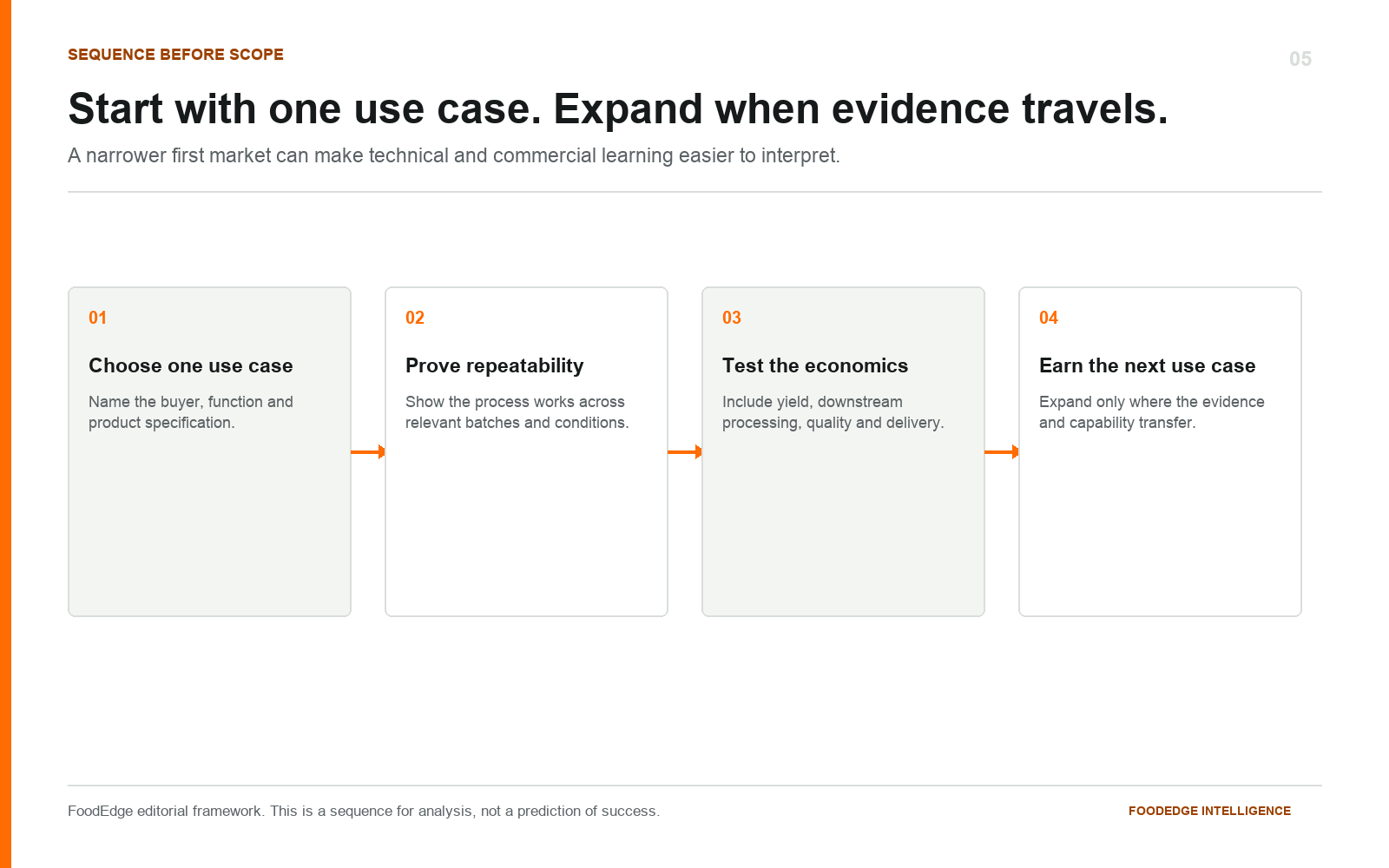
Focus is therefore not a permanent prohibition on expansion. Define the evidence that would justify the next application: a repeat order, a stable process, a funded customer project or a transferable manufacturing capability. Make expansion a decision triggered by evidence rather than a promise renewed at every board meeting.
Put a boundary around that first use case as carefully as you put a name on it. One ingredient sold to three industries can still mean three development programmes. A bakery buyer's processing requirements may differ from those of a beverage buyer. The same material can therefore create more commercial work than the single SKU in the financial model suggests. The useful unit of focus is the product in an application, with an identifiable route to acceptance.
Then write down the stopping rule. What result would show that the ingredient cannot meet the intended customer's requirements with the resources available? What evidence would justify one more experiment, and what would justify a different application? A first product becomes a discipline only when it is allowed to fail its own test. Otherwise ingredient-first is another label protecting a project from a decision.
The board should be able to see the next learning milestone, its cost and its consequence. A positive result may release manufacturing spend. A mixed result may narrow the brief. A negative result may preserve cash for a different option. The objective is to make the company more capable of choosing, rather than more committed to defending its original choice.
For innovators: separate scientific options from launch obligations
Technical optionality is a feature of good science. Premature commitments can make it a liability for a young company. The discipline is to preserve the option without pretending that every option is ready to become a product.
Start with one target performance problem and an explicit experimental plan. Connect the strain or process result to the ingredient specification, then connect that specification to the customer's food. An impressive titre does not by itself establish functionality, acceptable cost or reliable production.
The rest of the platform can benefit from the first programme. Analytical methods, process understanding and customer insights may transfer. Record what actually transfers and what must be rebuilt. Reuse is the evidence for a platform; an application list is the hypothesis.
The hardest scientific founder conversation may be accepting that a credible technology thesis still needs a commercial sequence. The first ingredient supplies that sequence with a concrete test. When it ships and the buyer comes back, the company has learned something that no diagram of future applications could establish.
If you had to keep one first ingredient, which one would justify the company, and what evidence would persuade a buyer to order it again?
Sources and editorial basis
This is a revised version of the author's original essay, first published on 16 April 2026. Company and regulatory sources were checked on 16 October 2026. Links above identify the documents supporting factual statements. Company-reported capacity, plans and progress remain attributed to the company. Strategic recommendations and the sequencing diagrams are the author's analysis, not measured comparative performance or a guaranteed regulatory timetable.


