China has approved β-lactoglobulin made by fermentation as a new food raw material, the first time the country has cleared an edible protein produced by precision fermentation, according to CCTV News, citing the Shanghai Municipal Science and Technology Commission, and Cailian Press. The National Health Commission (NHC) dated the notice 12 November and it was published on 23 November as announcement 2026 No. 7. The specification requires at least 85 g of protein per 100 g, of which at least 90% is β-lactoglobulin.
At a glance
- 85 g/100 gminimum total protein, of which at least 90% must be β-lactoglobulin (NHC annex)
- Firstprecision-fermented edible protein approved as a new food raw material in China (CCTV News; Cailian Press). The official notice itself does not use the word “first”
- K. lactisCJ-B1-P22 is the production yeast; the gene donor is the cow, Bos taurus (NHC annex)
- Not for infantsand not recommended for people with milk or dairy allergies; the label must name the unsuitable groups (NHC notice)
National Health Commission announcement 2026 No. 7, dated 12 November 2026 and published 23 November 2026, with annex 1 and the Commission’s interpretation. CCTV News via The Paper, 24 November 2026; Cailian Press, 23 November 2026. Checked 25 November 2026.
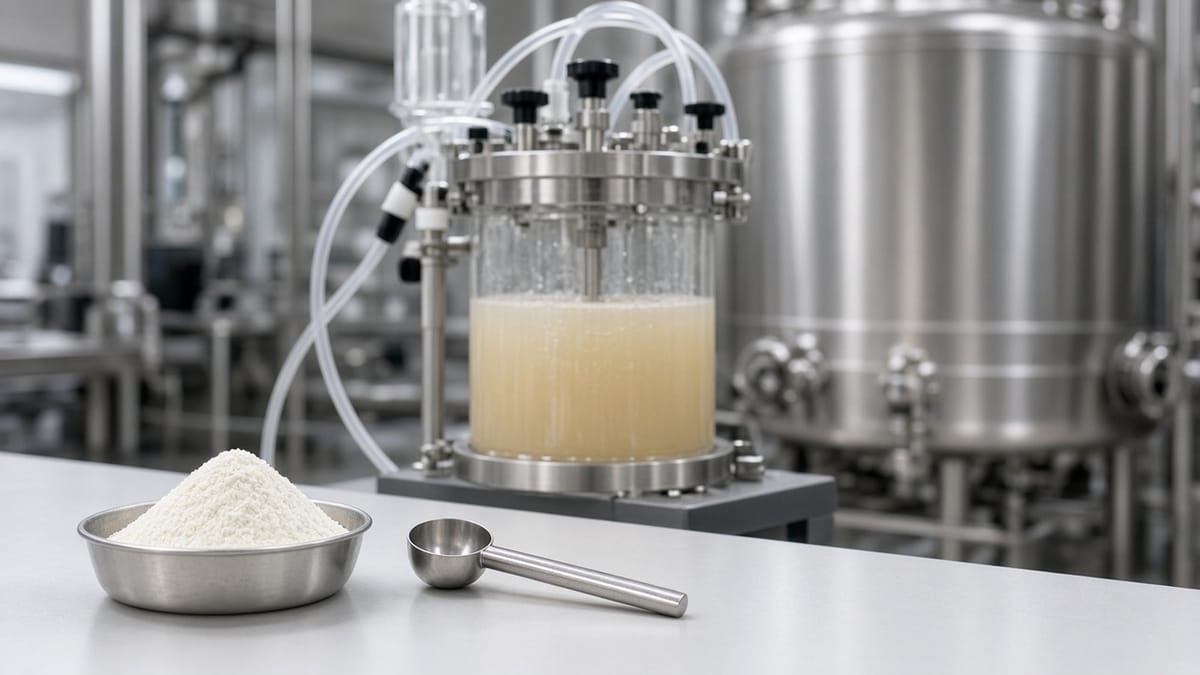
The approved ingredient, listed in English as “Beta-lactoglobulin (fermentation)”, is made from glucose and ammonium sulphate, fermented by Kluyveromyces lactis CJ-B1-P22, then isolated, purified and dried. It is specified as a white to off-white powder. Moisture must be no more than 5.0 g/100 g and ash no more than 4.0 g/100 g, with limits for lead, cadmium, mercury, arsenic and named microbes (NHC annex 1, carried in full by China News Service and on the Inner Mongolia Health Commission site).
The NHC’s own interpretation of the same notice, carried by Pharnexcloud and China Food News, adds that the ingredient also contains carbohydrate and fat, and that fermented β-lactoglobulin is already managed as generally recognised as safe (GRAS) in the United States and has been approved as a novel food in Canada. Those comparisons refer to the substance class. The Chinese notice does not name a US or Canadian dossier, and it does not say that the Chinese applicant holds those clearances.
36Kr, citing Shanghai Science and Technology, and Cailian Press, which says it spoke to the company, both name the developer as Shanghai Changjin Biotechnology Co., Ltd. (上海昌进生物科技有限公司). The 2026 notice itself does not name the applicant. The Commission’s public acceptance list of 6 February 2025 records an application for “β-lactoglobulin (non-animal source)” under number 卫食新申字(2025)第0009号, without naming the applicant on the published table. No plant, annual volume or price is given in the announcement, the interpretation or the press reports FoodEdge opened.
CCTV News, citing the Shanghai Municipal Science and Technology Commission, says several research groups in Shanghai ran small-scale fermentation and process scale-up work on β-lactoglobulin under the Commission’s coordination (single source, the CCTV report, also carried by The Paper and the National Centre for Science and Technology Innovation). That report does not name Changjin.
FoodEdge view: a legal path with no named factory
Our reading is that China has opened a legal route for a precision-fermented dairy protein, with a tight specification and two hard limits: no use in infant foods, and mandatory labelling for people who cannot eat milk. The annex names a yeast strain and a bovine gene donor, which is why the allergy restriction follows. The notice does not name a factory, a volume or a price. The Commission’s own interpretation already records that other regulators have seen fermented β-lactoglobulin, so the diligence work is on the Chinese process and the plant, not on whether the molecule is new to the world.
The due diligence question: which plant will make food-grade material to this 85/90 specification, at what annual volume, and what residual host-protein data sits behind the allergy label?
Not investment, legal, or professional advice.
Weighing a food biotech or nutrition deal? Independent technical due diligence, before you sign.
How we checked
- Sources: National Health Commission announcement 2026 No. 7, dated 12 November 2026, published 23 November 2026, and annex 1 (β-lactoglobulin specification and production-strain table); the Commission’s interpretation, carried by Pharnexcloud and China Food News; China News Service, 23 November 2026; Inner Mongolia Health Commission reprint, 25 November 2026; CCTV News via The Paper, 24 November 2026 and the same report on the NCSTI site; Cailian Press, 23 November 2026; 36Kr, 23 November 2026. Chinese sources translated by FoodEdge.
- Snapshot: 25 November 2026. Source copies (PDF, screenshot and archive.org snapshot) are kept with the working files.
- Key assumption: “first in China” is a reporting claim by CCTV News and Cailian Press about precision-fermented edible protein as a new food raw material. The official notice does not say “first”. FoodEdge treated filamentous fungal protein listed in an earlier NHC notice as a different category (biomass, not a named recombinant dairy protein).
- Main limit: the 2026 notice does not name the applicant. Changjin is identified by 36Kr, citing Shanghai Science and Technology, and by Cailian Press. The 2025 acceptance list confirms an application for “β-lactoglobulin (non-animal source)” under number 卫食新申字(2025)第0009号, but the public table does not name the applicant. No public volume, plant or price was found. The US GRAS and Canadian novel-food comparisons in the official interpretation are for the substance class, not a named dossier for this applicant. The NHC notice page itself returned a blank WAF response from the box; the official text was read from the annex PDF and from government and news republications.
AI tools supported source research and drafting during the editorial process.