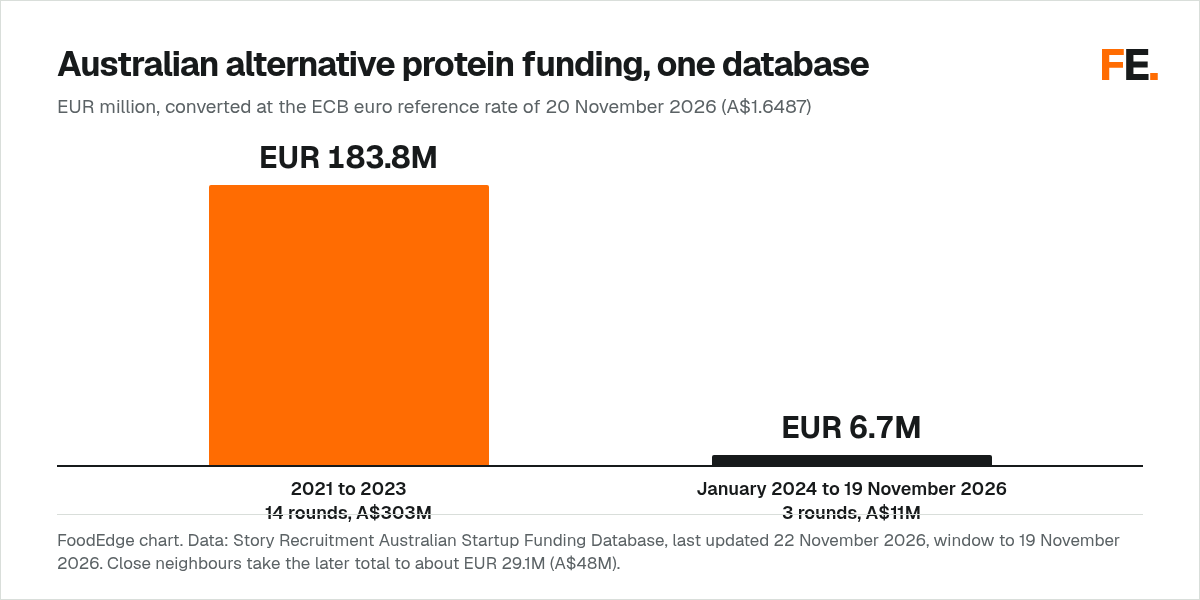
An open Australian startup-funding database, last updated on 22 November 2026, counts 14 alternative protein rounds worth about EUR 183.8M (A$303M) from 2021 to 2023, and 3 rounds worth about EUR 6.7M (A$11M) from January 2024 to 19 November 2026. I am using this count because it is the only public, documented tally of those rounds that I can open and check. About EUR 6.1M (A$10M) of the later total is one convertible note for All G. Story Recruitment, which publishes the database under a CC BY 4.0 licence, argues that money has moved toward factories. That line, quoted below, is a thesis to test. A contract fermentation plant still has to show utilisation and offtake before the raise holds.
At a glance
- EUR 183.8M(A$303M) across 14 rounds from 2021 to 2023 (Story Recruitment database)
- EUR 6.7M(A$11M) across 3 rounds from January 2024 to 19 November 2026 (same database)
- EUR 6.1M(A$10M) of that later total is All G’s December 2025 convertible note (Story; All G said “over A$10 million”)
- EUR 29.1M(A$48M) if close neighbours such as Cauldron are counted (same database)
Headline totals from the Story Recruitment Australian Startup Funding Database, last updated 22 November 2026. Euro amounts use the ECB reference rate of 20 November 2026 (A$1.6487). Checked 23 November 2026.
Story defines an alternative protein round as one by an Australian company whose main product is a plant-based, cultivated or fermented alternative to meat, dairy, eggs or animal fats, or a new protein ingredient for food. Under that definition, the three rounds since January 2024 are The Leaf Protein Co’s EUR 516,000 (A$850,000) pre-seed in June 2024, Harvest B’s pre-Series A in September 2025, and All G’s convertible note in December 2025. Story counted the Harvest B round but put no amount into the EUR 6.7M (A$11M) total, because, it says, reports give A$3.4M or A$5.6M.
The two trade articles FoodEdge opened on that raise, Business News Australia and SmartCompany, both dated 12 September 2025, state A$5.6M (EUR 3.4M), led by Mandalay Venture Partners. I have not opened a report that states A$3.4M. If Harvest B were counted at A$5.6M, the later core total would be higher than EUR 6.7M. I still use Story’s published A$11M figure and flag the gap.
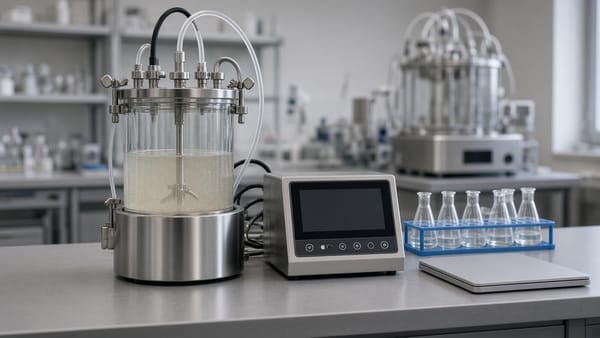
Add close neighbours, such as Cauldron, which runs fermentation plants that make ingredients for other companies, and Story’s later count becomes 7 rounds and about EUR 29.1M (A$48M). A further sensitivity case in the same article, adding a missed Nourish Ingredients figure of A$5.8M in 2023 (mostly government grants, Story says), Harvest B at A$5.6M, and those neighbours, gives about EUR 195.3M (A$322M) from 2021 to 2023 and about EUR 32.1M (A$53M) since 2024, a fall of more than 80%. I have not re-counted the underlying database row by row. Every headline total in this piece comes from that one dataset. On the core figures alone, A$11M against A$303M is a fall of about 96%. Story also reports that alternative protein’s share of all Australian rounds fell from 2.0% (14 of 696) in 2021 to 2023 to 0.5% (3 of 576) from January 2024. The divisions check (14/696 = 2.0%; 3/576 = 0.5%); the counts are Story’s.
Separate company and trade sources confirm the later rounds that matter for the factory reading. Cauldron’s own post and Food & Drink Business reported a EUR 5.8M (A$9.5M) Series A on 19 March 2024. In March 2026, Cauldron’s post, Food & Drink Business and Startup Daily reported a EUR 11.5M (A$19M) Series A2 led by Main Sequence, with Horizons Ventures, SOSV and NGS Super; Cauldron also stated that round as US$13.25M. The Leaf Protein Co’s pre-seed of EUR 516,000 (A$850,000) in June 2024 is in SmartCompany and Startup Daily. All G’s convertible note is in the company’s Business Wire release and in Startup Daily, both December 2025. Story counts A$10M (EUR 6.1M). The company release said “over A$10 million”, ahead of a Series B.
Cauldron sits in Story’s close-neighbour group, not among the three core alternative protein rounds. The reading that money is following factories depends on that wider net. The core later total, on Story’s own arithmetic, is mostly one convertible note plus a pre-seed.
“Money is following the factories, not the brands.”
Story Recruitment, Australian Alternative Protein Startup Funding, last updated 22 November 2026
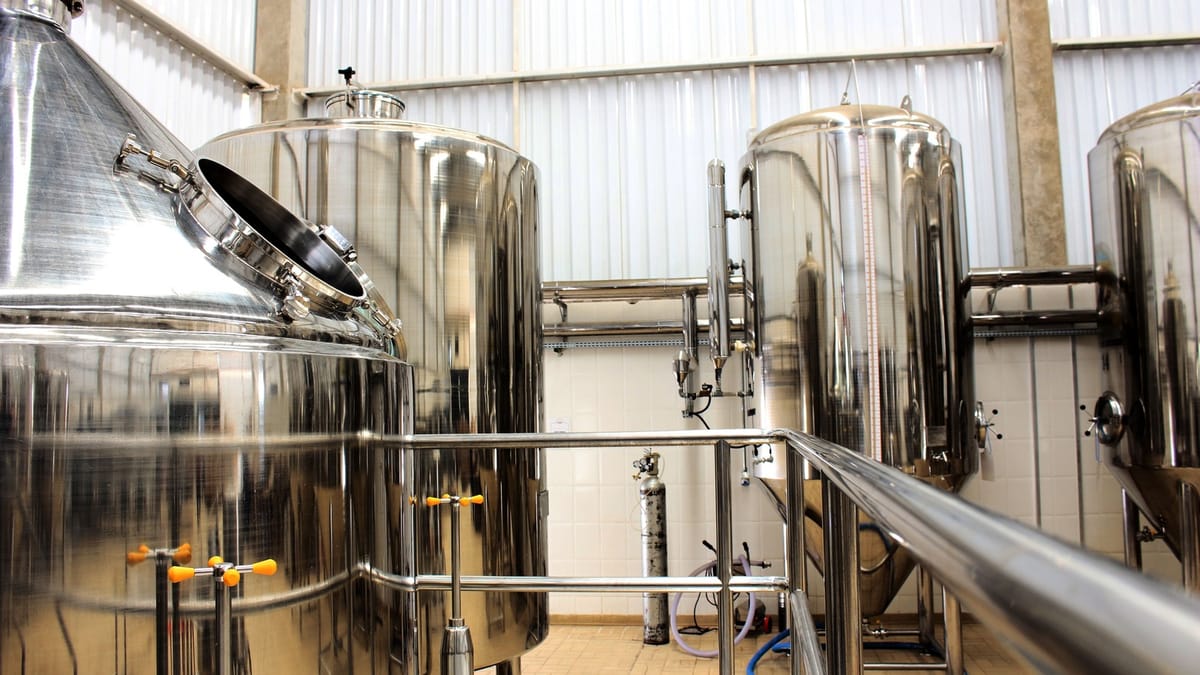
Europe has been having the same argument in a different form: whether a fermentation company should rent capacity or build a plant. A funded plant is a start. It is not proof that the plant will be filled. Before treating a contract fermentation raise as a shift in the market, I would ask who the anchor customers are, what utilisation is contracted, whether those contracts are take-or-pay, and what happens to the plant if a brand customer delays. All G’s later US lactoferrin filing is already on FoodEdge as a separate, self-affirmed GRAS story. It does not tell you how Australian alternative protein funding as a whole has moved.
Story is clear that the data show when the money stopped, not why. The explanations it offers, softer plant-based sales, higher rates, and investor rotation into other deep tech, are the author’s view. I share the caution. The counts are usable. The causes are not measured.
FoodEdge view: the fall is clear, the factory thesis is still a test
My reading is that the drop in the core count is large enough to matter for anyone pricing an Australian fermentation or alternative protein deal, even after the definition is given a wide berth. Cauldron’s two later raises make the factory thesis plausible. They do not show utilisation, offtake or take-or-pay terms. I would not underwrite a contract plant on the fact of a raise alone.
The due diligence question: which tonnes are contracted, on what terms, and at what utilisation does the plant cover its cost of capital?
Weighing a food biotech or nutrition deal? Independent technical due diligence, before you sign.
How we checked
- Sources: Story Recruitment, last updated 22 November 2026, CC BY 4.0, including the sensitivity totals; Cauldron posts of 19 March 2024 and 26 March 2026, with Food & Drink Business and Startup Daily; All G’s Business Wire release and Startup Daily, December 2025; The Leaf Protein Co in SmartCompany and Startup Daily, 12 June 2024; Harvest B in Business News Australia and SmartCompany, 12 September 2025; ECB euro reference rates.
- Snapshot: 23 November 2026, of the Story page last updated 22 November 2026. The database window stated is 19 November 2026 (1,951 announced rounds from January 2016). Euro amounts use the ECB reference rate of 20 November 2026 (A$1.6487), which was still the latest daily rate on 23 November. Shares: 14 of 696 is 2.0%; 3 of 576 is 0.5%.
- Key assumption: Story’s definition of alternative protein. Adding close neighbours changes the since-2024 total from about EUR 6.7M (A$11M) to about EUR 29.1M (A$48M). At the 19 November rate (A$1.6378), the 2021 to 2023 total is EUR 185.0M rather than EUR 183.8M; the EUR 6.7M later total is unchanged at one decimal place.
- Main limit: the headline totals come from one database. FoodEdge did not re-count every row. Story says it added missed rounds on 18 November 2026 and that live views may include later announcements. The “why” and the factory thesis are readings. They are not measurements of the database. Story left Harvest B’s amount out of the A$11M total; the two trade articles opened both state A$5.6M. Dated copies of the sources, with SHA256 hashes, are in the 23 November 2026 pack at drafts/2026-11-21/sources/w1/.
AI tools supported source research and drafting during the editorial process.